
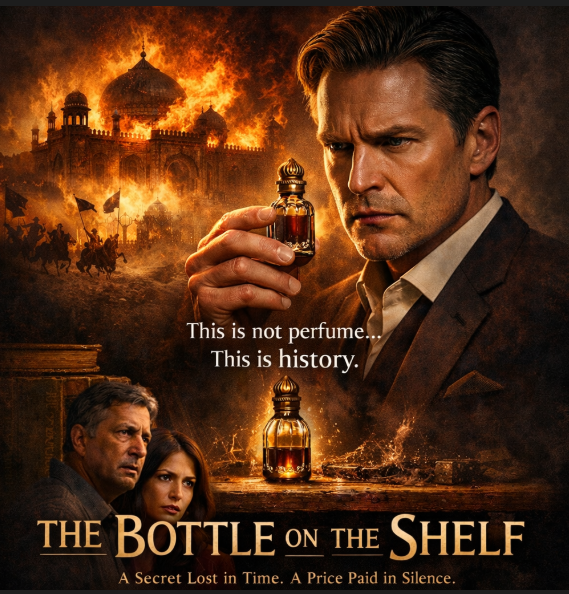
The house was quiet in the way only old houses were—quiet, but never truly silent. The walls carried memories, whispers of lives lived slowly and without ambition. The furniture was simple, worn but clean. Nothing in the room suggested wealth, rarity, or history.
Nothing—except the bottle.
The man noticed it the moment he stepped inside.
He was dressed in a perfectly tailored suit, the kind that did not shout for attention but commanded it anyway. His shoes were polished to a mirror shine, his posture straight, his movements controlled. He was used to walking into rooms where people watched him carefully, trying to read his intentions.
But this room did not watch him.
He took two steps forward and then stopped.
On a wooden shelf, half-hidden between old books and a cracked photo frame, stood a small glass bottle of ittar. It was no bigger than a man’s thumb, cloudy with age, its stopper slightly uneven. To anyone else, it looked ordinary—cheap, even forgettable.
To him, it was impossible.
His breath caught in his throat.
Time slowed.
The faint smell in the air—warm, deep, almost alive—reached him before his mind accepted what his eyes were seeing. His heart began to pound, not with excitement, but with something closer to fear.
He stared at the bottle as if it might disappear if he blinked.
“Where did you get this?”
His voice came out low, strained, nothing like the confident tone he usually carried.
The homeowner, a middle-aged man with tired eyes and a gentle face, looked surprised by the question. He followed the man’s gaze to the shelf and frowned slightly.
“That?” he said. “I don’t know. My wife bought it.”
The well-dressed man took a step closer, careful, as if approaching something sacred—or dangerous.
“From where?” he asked.
The homeowner shrugged. “Some cheap market. One of those roadside stalls. She liked the smell.”
The words hit him like a physical blow.
A cheap market.
For a moment, the well-dressed man laughed softly, a hollow sound without humor. He raised a hand to his forehead, pressing his fingers against his temple as if grounding himself.
“You have no idea,” he said quietly, “what you are keeping on this shelf.”
The homeowner shifted uncomfortably. “It’s just perfume,” he said. “If you like it, I can ask her where she got it.”
The man’s head snapped up.
“Perfume?” he repeated.
He turned slowly, his eyes dark, sharp, filled with a seriousness that drained the warmth from the room.
“This,” he said, pointing at the bottle, “is not perfume.”
He reached out but stopped just short of touching it. His hand trembled.
“This bottle,” he continued, voice heavy and controlled, “is almost six hundred years old.”
The homeowner laughed nervously. “That’s not possible.”
The man finally looked at him fully now.
“I’ve spent my entire life studying artifacts like this,” he said. “Royal distillations. Lost blends. Oils made for kings who believed scent could protect their soul in the afterlife.”
He turned back to the bottle.
“This ittar was crafted long before your country existed as it is today. Before borders. Before names.”
The room felt colder.
The homeowner swallowed. “You’re saying… it’s old?”
“I’m saying,” the man replied, “that there are records of this exact blend disappearing during a palace fire in the 15th century.”
He closed his eyes briefly, as if remembering something painful.
“They called it Al-Qadim,” he said. “The Ancient One.”
The homeowner’s voice dropped to a whisper. “Why would something like that end up in a cheap market?”
The man opened his eyes.
“Because history doesn’t care who understands it,” he said. “It survives where it can.”
Silence stretched between them.
The well-dressed man straightened his jacket, regaining control of himself. When he spoke again, his tone was calm—but dangerous.
“Sell it to me,” he said.
The homeowner blinked. “What?”
“Name your price.”
The homeowner shook his head slowly. “You’re serious.”
“I have never been more serious in my life.”
The homeowner looked back at the shelf, then at the man. “If it’s really that valuable, why would you want it so badly?”
The man hesitated.
Then, for the first time, his voice softened—not with kindness, but with weight.
“Because some things should not be lost twice.”
The homeowner hesitated. “Lost twice?”
The man finally picked up the bottle. The glass was cool, heavier than it looked.
“This ittar was made for a ruler who believed enemies could be identified by scent alone,” he said. “It was said that those who wore it could sense danger before it arrived.”
He smiled faintly, without joy.
“Most people called it superstition.”
The homeowner asked quietly, “And you?”
“I think,” the man said, “some knowledge disappears not because it’s false—but because it’s dangerous.”
He placed the bottle back gently.
“You’ve been keeping this here for years,” he said. “Did you ever notice strange dreams? Moments when time felt… wrong?”
The homeowner’s face went pale.
“My wife,” he said slowly. “She says she dreams of old places. Fires. Crowns.”
The man nodded once. “That’s what I was afraid of.”
He reached into his coat and pulled out a small leather wallet. Inside were cards, documents, names the homeowner didn’t recognize.
“I can protect you from what comes with this,” the man said. “But only if it leaves this house.”
The homeowner took a deep breath. “And if I say no?”
The man met his eyes.
“Then history will decide for you.”
Another long silence.
Finally, the homeowner spoke. “My wife bought it for five dollars.”
The man allowed himself the faintest smile.
“I’ll give you enough that you’ll never need to shop at cheap markets again,” he said. “And enough to forget you ever saw this bottle.”
The homeowner looked once more at the shelf, at the small, unassuming bottle that had changed the air in his home.
“Take it,” he said.
The man nodded respectfully, wrapped the bottle in a silk cloth, and slipped it into his inner pocket.
As he walked toward the door, he paused.
“You did the right thing,” he said.
The homeowner asked, “Will we ever hear about it again?”
The man opened the door.
“No,” he said. “That’s the point.”
The door closed.
The house returned to silence.
But the shelf felt emptier than it ever had before.