
I’ve never told anyone about the night my hands started shaking in Corridor C, even though I’d held dying patients, screaming relatives, and broken bodies without flinching before.
Hospitals train you to expect chaos—but not that kind. Not the kind that walks toward you in polished shoes, a tailored suit, and eyes so calm they feel dangerous.
It was 2:17 a.m. The hour when machines breathe louder than people and the building feels half-asleep, half-haunted. I was guiding a medication trolley back toward the ICU when I saw him.
A well-dressed man. Black suit. Crisp white shirt. No tie, collar open like he’d torn himself free from something formal and suffocating. His shoes clicked against the floor—sharp, impatient. He didn’t look lost. He looked like someone who had already decided the world should move aside for him.
I stepped into his path instinctively. Protocol. Training. Habit.
“Sir,” I said, keeping my voice even, professional. “This area is restricted.”
He didn’t slow down.
Then it happened faster than my mind could process.
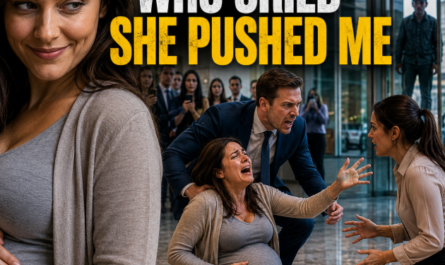
His hand came out—not wild, not panicked—controlled and forceful. It struck my shoulder and shoved me aside.
“Get out of my way.”
The words weren’t shouted. That scared me more.
I stumbled back, my heel catching the edge of a floor tile. For a split second, I thought I might fall. The trolley rattled. A clipboard slipped from a doctor’s hand nearby. Someone gasped. Someone else froze mid-step.
The corridor went silent in the strangest way—like the hospital itself was holding its breath.
Pain flared in my arm, sharp and humiliating. But worse than the pain was the shock. Not fear yet. Shock.
I straightened, my heart pounding so hard I could hear it in my ears.
“Sir, you can’t do that.”
My voice trembled. I hated that it did.
He turned then. Slowly. As if I’d merely inconvenienced him, like a fly buzzing near his face.
“I said move.”
There it was. Authority without uniform. Anger without chaos. A man used to being obeyed.
I felt every eye in the corridor on us. Doctors. Interns. A patient in a wheelchair clutching his IV pole. Another nurse frozen beside a curtain.
No one moved.
And then a third voice cut through the tension.
“Step back. That’s enough.”
It came from behind him—firm, loud, undeniable. Security? A senior doctor? I didn’t know. I didn’t look. My eyes were locked on the man in front of me.
Something changed in him.
It was subtle. Terrifyingly subtle.
His shoulders relaxed. His jaw unclenched. The storm inside him vanished like it had never existed.
He turned slightly, raised one hand in a calming gesture, and said—almost gently—
“I’m fine.”
Three words.
And just like that, the corridor exhaled.
People moved again. The spell broke. Sound rushed back in—machines beeping, shoes scraping, murmured whispers.
But I couldn’t move.
Because in that moment, I understood something that took me years to put into words.
That man wasn’t angry because he lacked control.
He was angry because he had too much of it—and for once, it wasn’t working.
After security escorted him away, after supervisors asked if I was okay, after forms were filled and apologies offered, I went into the supply room and sat on the floor between boxes of gloves and saline.
My hands wouldn’t stop shaking.
Everyone assumed I was shaken because I’d been pushed.
They were wrong.
I was shaken because when he looked at me—really looked—I saw grief so deep it had hardened into something sharp and dangerous.
Later, much later, I learned who he was.
A father.
His daughter had been brought in an hour earlier. Car accident. Internal bleeding. The kind that doesn’t scream right away. The kind that waits.
He had arrived just after the surgeons rushed her into emergency surgery. No answers. No permission. No control.
Just waiting.
People think anger like that comes from arrogance.
It doesn’t.
It comes from helplessness wearing an expensive suit.
I replay that moment often—the push, the words, the sudden calm. And every time, I ask myself the same question:
What kind of pain turns a person into a weapon for just a few seconds?
I don’t excuse what he did. I never will. Violence is violence, even when it’s quiet and controlled.
But I understand it now in a way I didn’t then.
Hospitals see people at their most honest. Titles fall away. Manners crack. Masks slip.
That night, I saw a man standing on the edge of losing the only thing that made his power meaningless.
And I saw myself—small, shaken, still standing.
I finished my shift.
I went home.
I didn’t tell anyone.
Because some stories don’t belong to gossip or reports or even memory.
Some stories live in the silence between heartbeats—where anger, fear, and humanity collide.
And every time I walk down Corridor C at 2 a.m., I still hear his shoes.
Click.
Click.
Click.
And I remind myself why I stay.
Because even when people push you away at their worst—
They’re still people.