The man parked where no one ever stopped.
Not because it was illegal.
Not because it was dangerous.
But because it was forgotten.
The river moved slowly beside the road, thick and dark, reflecting the pale orange light of early morning. No joggers. No fishermen. No passing cars. Just silence—broken only by the soft ticking of an engine cooling down.
The trunk opened with a dull metallic sound.
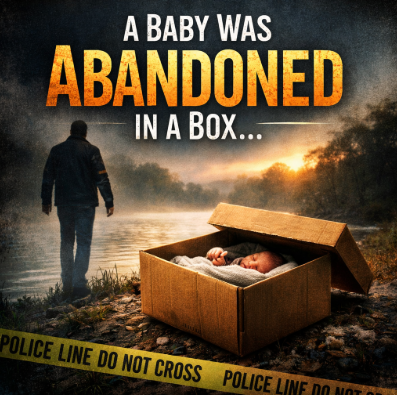
Inside sat a cardboard box.
The lid wasn’t fully closed.
And from inside that box came the smallest movement—barely noticeable, like the breath of something trying not to be heard
He stood there longer than he planned.
Thirty-eight years old. Clean jacket. No visible tattoos. No criminal look. The kind of man you’d trust with your car keys. The kind of man you’d never suspect.
His eyes scanned the road once. Twice.
Then he leaned forward.
Inside the box, wrapped in a thin hospital blanket, was a newborn baby—no more than four or five days old. Tiny fingers curled into fists. Skin still pink. Fragile. Alive.
The baby didn’t cry.
That was the part that made his throat tighten.
He shut the lid carefully.
Too carefully.
As if loud noise might change his mind.
He lifted the box. It weighed almost nothing, yet his arms felt like they were carrying something heavier than concrete. Each step toward the river felt slower, like the ground itself was resisting him.
When he reached the edge, he stopped.
For a moment—just one moment—it looked like he might turn back.
Instead, he set the box down near the riverbank.
Not in the water.
Not yet.
“I’m sorry,” he whispered.
Then he walked away.
What no one tells you about moments like these is that they don’t feel dramatic.
There’s no music.
No lightning.
No sudden realization.
Just quiet decisions that change lives forever.
The baby inside the box moved again.
A soft sound escaped—weak, but unmistakable.
A sound that meant time was running out.
Two miles away, Sarah Whitman was already late.
Late for court. Late for a custody hearing she couldn’t afford to lose. Late for a life that had been falling apart ever since her husband’s accident left her buried under medical bills and insurance disputes that never seemed to end.
She didn’t believe in coincidences.
She believed in paperwork, deadlines, and the brutal reality of the American legal system—where one missed document could cost you everything.
She tightened her grip on the steering wheel as she took the back road by the river, hoping to avoid traffic.
She never took this road.
Her phone buzzed.
Another message from her attorney.
Another reminder that if today didn’t go right, her eight-year-old son might not come home with her.
She exhaled sharply and kept driving.
That’s when she saw the box.
It didn’t belong there.
Not on the riverbank.
Not at that hour.
Not half-hidden by weeds like someone wanted it seen—but not too quickly.
She slowed down.
Then stopped.
Her instincts screamed at her to keep going. People got into trouble all the time for stopping. Lawsuits. Police reports. Liability issues. She knew the risks better than most.
But something about that box felt wrong.
She stepped out of the car.
The river smelled damp and cold.
The box was close enough now that she could see the lid wasn’t sealed.
Her heart began to race.
“Hello?” she called out.
No answer.
She took another step.
Then she heard it.
A sound so soft it barely carried over the water—but once heard, impossible to ignore.
A baby.
Alive.
Her knees nearly gave out.
She rushed forward, hands shaking as she opened the lid.
Inside was a newborn.
Alone.
Her legal problems vanished from her mind in an instant.
This was bigger than court dates. Bigger than custody battles. Bigger than insurance claims and legal fees.
This was life.
She grabbed her phone and dialed 911.
Her voice cracked as she spoke.
“There’s a baby,” she said. “Someone left a baby by the river. Please—please hurry.”
As she waited, she wrapped the child in her coat, holding him close, feeling his weak heartbeat against her chest.
He was cold.
Too cold.
Sirens arrived fast.
Police. Paramedics. Questions.
Too many questions.
Where did you find him?
Did you see anyone leave?
Did you touch the box?
Did you move anything?
Sarah answered everything honestly, unaware that each word she spoke was already becoming part of a case that would soon attract media attention, legal scrutiny, and a criminal investigation that went far deeper than simple abandonment.
Because this baby wasn’t supposed to be found.
Across town, the man sat in his car, hands trembling, staring at his reflection in the rearview mirror.
His phone buzzed.
One message.
Just three words.
“Plan failed. Baby found.”
His jaw clenched.
This wasn’t how it was supposed to go.
The baby was rushed to the hospital.
Doctors confirmed what no one wanted to hear.
He had been exposed to cold long enough to cause complications—but not long enough to be irreversible.
He would survive.
For now.
News broke within hours.
“Newborn Found Abandoned Near Riverside Road.”
“Police Searching for Suspect.”
“Hero Woman Discovers Baby on Way to Court.”
Sarah’s name was everywhere.
So was the baby.
But the man who left him?
Still invisible.
What the public didn’t know—what no one knew yet—was that this baby wasn’t abandoned out of fear.
He was abandoned because of money.
Because of a document signed in a hospital room.
Because of an insurance policy worth millions.
And because someone believed a child was easier to erase than a mistake.
As Sarah stood outside the hospital nursery that night, watching the baby sleep behind glass, she felt something she hadn’t felt in years.
Purpose.
She didn’t know his name.
She didn’t know his past.
But she had a feeling—deep and undeniable—that saving this child would cost her more than she ever imagined.
And that the man who walked away from the river?
He wasn’t done yet.
END OF PART 1