
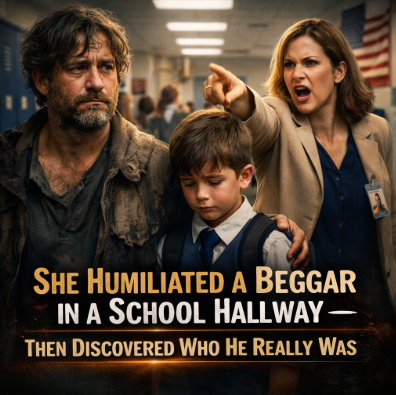
“The Price of Looking Poor”
The administrator’s office was quiet.
Too quiet.
The door closed softly behind Daniel Carter and his son, muting the noise of the hallway and the whispers that still followed them like shadows.
The boy sat on the edge of a leather chair, feet dangling, hands folded in his lap. He stared at the floor, afraid to touch anything. Afraid he might break something just by being there.
Daniel stayed standing.
He always did.
Sitting made people uncomfortable. Standing reminded them he was temporary.
The administrator, Mrs. Reynolds, didn’t sit either. She stared at her tablet for a long moment, then looked up at Daniel again, as if confirming what she was seeing.
“I didn’t expect to see you like this,” she finally said.
Daniel gave a small, tired smile. “Most people don’t.”
The boy looked up. “Dad… do you know her?”
Mrs. Reynolds crouched down so she was eye level with him.
“Yes,” she said gently. “Your father and I have met before.”
The boy blinked. “When?”
Daniel placed a hand on his son’s shoulder. “A long time ago. Before things went wrong.”
Mrs. Reynolds stood and took a breath.
“Mr. Carter,” she said, choosing her words carefully, “your payment cleared. Your son is fully enrolled. No question about that.”
Relief washed over the boy’s face—but it didn’t reach Daniel’s eyes.
“That’s good,” Daniel said. “I just want him to learn. To have a chance.”
Mrs. Reynolds nodded. “And he will.”
She hesitated.
“Daniel… what happened?”
Daniel looked away.
Outside the window, children played on the field. Their laughter felt like another world.
“I used to work in corporate finance,” he said quietly. “Mid-level executive. Good salary. Good benefits. We lived well.”
The boy’s mouth fell open.
“Dad… you never told me that.”
Daniel swallowed. “Some stories are heavy, son.”
Mrs. Reynolds remembered.
She remembered Daniel Carter clearly now. The man who once donated thousands to the school district. The man who spoke at scholarship dinners. The man who wore tailored suits and shook hands with board members.
The man who vanished.
“There was an investment firm,” Daniel continued. “They cooked the books. When the investigation started, they needed a fall guy.”
Mrs. Reynolds felt a chill.
“And you refused to play along,” she said.
Daniel nodded. “I reported them. Every document. Every email.”
“And they destroyed you,” she whispered.
“Blacklisted,” Daniel said. “No firm would touch me. Lawsuits drained everything. Medical bills finished the job after my wife got sick.”
The room felt smaller.
The boy’s eyes filled with tears. “Mom…”
Daniel squeezed his shoulder. “She fought hard.”
Mrs. Reynolds turned away, blinking fast.
“And now?” she asked.
“Now I do day labor when I can. Sleep where I can. Save every dollar for him,” Daniel said, his voice steady despite the weight of it. “Because he’s smarter than I ever was.”
The boy looked up at him, pride mixing with pain.
A knock interrupted them.
Mrs. Reynolds straightened. “Come in.”
The door opened.
Ms. Caldwell stepped inside.
Her confidence was gone.
“I was told to report here,” she said stiffly.
Mrs. Reynolds didn’t invite her to sit.
“Ms. Caldwell,” she said, cold and professional, “do you understand why you’re here?”
“I… enforced school policy,” Ms. Caldwell replied.
Mrs. Reynolds raised an eyebrow. “By publicly humiliating a parent and child?”
“I assumed—”
“That’s the problem,” Mrs. Reynolds snapped. “You assumed.”
Ms. Caldwell glanced at Daniel, then quickly looked away.
“I didn’t know who he was,” she muttered.
Daniel spoke calmly. “That shouldn’t matter.”
The words hit harder than anger.
Mrs. Reynolds nodded. “Exactly.”
She turned to Ms. Caldwell. “You judged based on appearance. And you did it loudly.”
Ms. Caldwell’s face flushed. “I was maintaining standards.”
“No,” Mrs. Reynolds said sharply. “You were protecting comfort. Yours.”
Silence stretched.
“Effective immediately,” Mrs. Reynolds continued, “you are suspended pending review.”
Ms. Caldwell’s eyes widened. “You can’t be serious.”
“I am.”
Ms. Caldwell opened her mouth to argue—then closed it. She looked at Daniel one last time, her expression unreadable, before leaving the room.
The door shut.
The boy let out a breath he didn’t realize he was holding.
“Dad… are we in trouble?”
Daniel knelt in front of him.
“No,” he said softly. “You’re exactly where you’re supposed to be.”
Mrs. Reynolds cleared her throat.
“There’s one more thing,” she said.
She tapped her tablet and turned it toward Daniel.
“Your son’s test scores. They’re exceptional. Off the charts.”
Daniel’s brow furrowed. “He studies by flashlight.”
Mrs. Reynolds smiled. “It shows.”
She took a breath.
“We have a scholarship fund,” she continued. “Full tuition. Books. Meals. Transportation.”
Daniel shook his head immediately. “No charity.”
“This isn’t charity,” Mrs. Reynolds said. “It’s investment.”
The boy’s eyes lit up. “Dad?”
Daniel closed his eyes.
For the first time in years, he allowed himself to breathe.
“Alright,” he said quietly. “For him.”
Later that afternoon, Daniel walked his son to class.
Heads turned again.
But this time, the whispers sounded different.
The boy stood taller.
“Dad,” he said before entering the classroom, “I’m not ashamed of you.”
Daniel smiled, eyes burning. “I was never ashamed of you.”
As Daniel turned to leave, Mrs. Reynolds caught up to him.
“One more thing,” she said.
“Yes?”
“The board would like to speak with you,” she said carefully. “About the investment firm you exposed.”
Daniel froze.
“They’re under investigation again,” she added. “This time… they won’t walk away.”
Daniel looked down the hallway where his son had disappeared into a classroom full of possibility.
“Good,” he said.
That evening, as Daniel sat alone on a park bench, his phone buzzed.
An unknown number.
He answered.
“Mr. Carter,” a voice said. “This is the State Financial Crimes Unit. We’d like to reopen your case.”
Daniel closed his eyes.
Justice, it seemed, had finally found him.
Across town, a teacher sat alone in her apartment, replaying the moment she told a man to leave because he looked poor.
And in a warm classroom, a boy wrote his name at the top of a brand-new notebook.
Proudly.
Because he had learned a lesson no school could teach:
Never judge a man by how broken his clothes are.
Judge him by what he refuses to break.
THE END