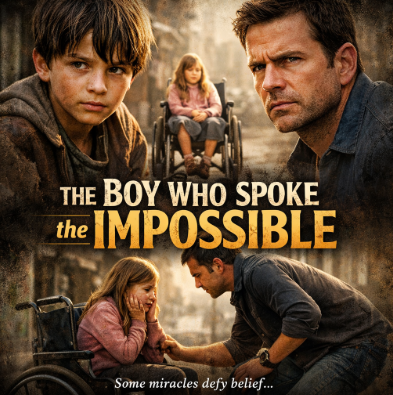
The first thing people noticed about Lily wasn’t the wheelchair.
It was her smile.
Bright, stubborn, out of place for a nine-year-old who hadn’t taken a single step since she was six.
She sat near the edge of the sidewalk outside a small park in downtown Phoenix, the afternoon sun casting long shadows across the concrete.
Her legs rested motionless beneath a pink blanket, while her hands—small and restless—clutched the armrests of her chair.
She watched children run past her, sneakers slapping the pavement, laughter echoing in bursts that rose and disappeared like birds.
Beside her stood her father, Mark Wilson.
Mark didn’t smile.
He stood with his arms crossed, jaw tight, eyes scanning the crowd the way men do when they’ve learned the world doesn’t give warnings before it hurts you.
He was thirty-six, broad-shouldered, neatly dressed, the kind of man who looked like he had his life under control—even when everything inside him was held together by strain and sleepless nights.
This was their routine.
Every Sunday afternoon.
Same spot.
Same park.
Lily liked watching people. Mark liked pretending he was fine.
They had been there maybe fifteen minutes when Lily noticed the boy.
He was standing across the street at first, half-hidden near a bus stop bench. He looked about ten. Maybe eleven. His clothes hung loosely on his thin frame—too big, too old, too torn.
The knees of his pants were ripped wide open, the fabric dark with dirt. His shoes didn’t match, and one was held together by what looked like electrical tape.
He wasn’t begging.
He was just… watching.
Lily leaned forward slightly in her chair. “Dad,” she whispered.
Mark followed her gaze and felt his shoulders stiffen.
The boy hesitated, then slowly stepped off the curb and crossed the street. Each step looked careful, like he’d learned the hard way that sudden movements made adults nervous. As he got closer, Mark could see his face clearly—sharp cheekbones, tired eyes, skin dulled by dust and sun.
A beggar kid, Mark thought.
Great.
The boy stopped a few feet away.
Up close, Lily noticed something strange. He wasn’t staring at her legs. Most people did. Some tried not to, which was worse. This boy wasn’t doing either.
He was looking at her face.
“Hi,” Lily said softly before her father could speak.
The boy swallowed. “Hi.”
Mark stepped forward immediately, positioning himself between them. “We don’t have any cash,” he said, firm but controlled. “Move along.”
The boy shook his head. “I’m not asking for money.”
That alone set off alarms in Mark’s head.
“Then what do you want?” Mark snapped.
The boy glanced at Lily again. His voice dropped, almost like he was afraid someone else might hear him. “I just… I think I can help her.”
Mark laughed once. Sharp. Humorless. “Help her how?”
The boy took another small step forward.
That’s when Mark shoved him.
It wasn’t violent enough to knock him down, but it was hard enough to send a clear message. The boy stumbled backward, catching himself just before falling.
“I said stay away from my daughter,” Mark barked. “You don’t get to play games with her.”
People nearby turned to look. A woman slowed her walk. A man stopped tying his shoe. Lily’s hands tightened on the armrests.
“Dad, please—” she started.
The boy straightened himself, brushing dirt off his sleeve. He didn’t look angry. If anything, he looked sad.
“I can make her walk again,” he said.
The words landed like a dropped plate.
The street noise faded for Lily. For a second, all she could hear was her own heartbeat pounding in her ears.
Mark stared at the boy, stunned. Then his face hardened.
“What did you just say?”
The boy didn’t raise his voice. “I said I can make her walk again.”
Lily’s eyes filled instantly. Not loud sobs—just tears spilling over, the kind that came when hope hurt more than sadness.
Mark felt something crack in his chest.
He bent down until he was eye-level with the boy, his voice shaking with restrained fury. “Doctors couldn’t do it,” he said. “Specialists. Surgeons. Physical therapists. Millions of dollars. And you think you can?”
The boy nodded once.
“Yes.”
That single word pushed Mark over the edge.
“You don’t know anything about her,” Mark snapped. “You don’t know what she’s been through. You don’t get to come in here and mess with her head.”
The boy’s jaw tightened, but he didn’t back away. “I know enough.”
“Oh yeah?” Mark scoffed. “What’s her diagnosis?”
The boy hesitated.
Lily looked at him through tears. “They said my spinal cord was bruised,” she whispered. “Incomplete injury.”
The boy’s eyes softened. “That’s why you still feel it sometimes,” he said gently. “In your feet. Like pins.”
Lily froze.
Her breath caught. “How do you know that?”
Mark felt a chill crawl up his spine.
The boy shifted his weight. “Because it didn’t break,” he said. “It went quiet.”
“That’s enough,” Mark snapped, standing up. “We’re leaving.”
He grabbed the handles of Lily’s wheelchair and turned it sharply away.
“Dad,” Lily cried. “Please—”
Mark didn’t stop.
Behind them, the boy called out, his voice trembling now. “Wait! I don’t need money. I don’t need anything. Just five minutes.”
Mark ignored him, pushing faster.
“You don’t understand,” the boy said, louder this time. “I’ve seen it before.”
Mark stopped.
Slowly, he turned back.
“You’ve seen what?” he demanded.
The boy took a breath, like he was stepping off a cliff. “Kids who couldn’t walk,” he said. “People who were told it was over.”
“And?” Mark challenged.
“And it wasn’t.”
The crowd had grown slightly. Not enough to draw attention from authorities, but enough that Mark could feel eyes on him. Judgment. Curiosity.
Lily looked up at her father, her face wet with tears. “Dad,” she whispered. “What if he’s telling the truth?”
Mark’s heart twisted.
He crouched beside her, his voice breaking despite himself. “Sweetheart,” he said quietly, “we’ve heard this before.”
She nodded. “I know.”
He brushed a tear from her cheek. “And it always hurts more when it’s not real.”
Behind them, the boy said softly, “It’s real.”
Mark stood again, anger and exhaustion colliding. “Listen,” he said sharply, “whatever scam you’re running—”
“It’s not a scam,” the boy interrupted. “I don’t even know how to explain it.”
“Then don’t,” Mark snapped. “Just go.”
For a moment, the boy didn’t move.
Then he reached into his pocket.
Mark’s muscles tensed instantly. “Don’t.”
The boy slowly pulled out something small and worn—a folded photograph.
He held it out with shaking fingers.
“This was my sister,” he said. “She was in a chair too.”
Lily leaned forward. The picture showed a little girl, maybe seven, sitting in a wheelchair… and another photo beside it, taped crookedly.
The same girl. Standing.
Lily gasped.
Mark stared at the photo, his mouth dry.
“Where is she now?” Mark asked quietly.
The boy lowered his hand.
“She’s gone,” he said. “But she walked before she left.”
Silence settled between them.
Mark wanted to throw the photo back in his face. Wanted to scream. Wanted to believe.
And that was the scariest part.
Because for the first time in three years…
hope didn’t feel stupid.
It felt dangerous.
Part 2
Mark didn’t touch the photograph.
It hovered between them like something fragile—like it might shatter if anyone breathed too hard.
Lily was the first to reach for it.
Her fingers trembled as she took the worn picture from the boy’s hand. She studied it closely, her eyes moving from the girl in the wheelchair to the crooked second photo taped beside it. Same hair. Same face. Different posture. Standing.
“Dad…” Lily whispered.
Mark swallowed hard. His throat felt tight, like it did right before bad news.
“This proves nothing,” he said, though the words sounded weaker than he intended. “Pictures can be faked.”
The boy nodded. “I know.”
That answer caught Mark off guard.
“I don’t expect you to believe me,” the boy continued. “If I were you, I wouldn’t.”
“Then why are you here?” Mark demanded.
The boy hesitated, then looked at Lily again. “Because she looks like my sister did. The way she watches people walk like she’s memorizing it.”
Lily flinched.
Mark felt a sharp pain behind his eyes.
“What’s your name?” Mark asked quietly.
“Eli,” the boy said.
Mark exhaled slowly. “Eli,” he repeated. “You don’t get to say things like that to a child.”
“I know,” Eli said. “That’s why I waited.”
“Waited for what?”
“For her,” Eli said simply. “Not you.”
Mark turned toward Lily. “Did he say anything to you before today?”
Lily shook her head. “No. I just… I felt like he wasn’t lying.”
Mark closed his eyes for a moment.
Three years.
Three years of doctors’ offices that smelled like disinfectant and disappointment. Three years of medical terms that sounded hopeful until they weren’t. Three years of watching his daughter learn how to smile while hurting.
He opened his eyes again. “If this is some kind of trick—”
“It’s not,” Eli said quickly. “I don’t want money. I don’t want attention. I won’t even ask you to believe me.”
“Then what do you want?” Mark snapped.
“Time,” Eli said. “Just a little.”
Mark laughed bitterly. “You have any idea how many people have asked us for that?”
“I know,” Eli replied. “That’s why I won’t ask for much.”
Lily tugged on her father’s sleeve. “Dad… please.”
Mark looked down at her. Her face was hopeful in a way he hadn’t seen in years. Not excited. Not naive.
Careful.
Hope with bruises.
That scared him more than disappointment.
“Five minutes,” Mark said at last. “That’s it.”
Eli nodded. “Thank you.”
They moved to a quiet patch of grass near the edge of the park. Mark locked the wheelchair brakes himself, his hands steady out of habit, not confidence.
“Tell me exactly what you plan to do,” Mark said.
Eli crouched in front of Lily, careful to keep his distance. “I’m not going to touch her,” he said. “Not unless she says yes.”
Mark’s jaw tightened but he didn’t object.
Eli closed his eyes briefly, like he was concentrating. Then he opened them.
“Lily,” he said gently, “can you feel your feet right now?”
She nodded slowly. “A little. Like they’re asleep.”
“That’s good,” Eli said. “That means the message still gets through sometimes.”
Mark scoffed. “Doctors said that too.”
Eli didn’t argue. “I’m not a doctor.”
“Then what are you?”
Eli didn’t answer right away.
“Someone who watched his sister disappear,” he said finally. “And didn’t accept it.”
Lily’s hands clenched. “What do I do?” she asked.
“Nothing yet,” Eli replied. “Just tell me when it hurts.”
Mark stepped closer. “I’m watching you.”
“I hope you are,” Eli said.
He took a small stone from the ground and rolled it gently toward Lily’s foot. It stopped against her shoe.
“Can you feel that?” Eli asked.
Lily frowned. “Barely.”
Eli nodded. “That’s okay.”
He picked up the stone and pressed it lightly against her shoe again. “How about now?”
“A little more,” Lily said.
Mark’s chest tightened.
“That’s not impossible,” Mark muttered. “That’s nerves.”
Eli looked up at him. “Exactly.”
Mark froze.
Eli turned back to Lily. “Close your eyes,” he said. “Don’t think about walking. Don’t think about standing. Just think about your feet.”
She closed her eyes obediently.
Eli spoke softly, his words slow and deliberate. “Your legs didn’t forget you,” he said. “They’re just scared.”
Mark felt his hands curl into fists. “This is ridiculous.”
“Then stop me,” Eli said calmly. “You’re still in control.”
Mark didn’t move.
Lily’s breathing changed—slower, deeper.
“I feel warm,” she whispered.
Mark’s heart slammed against his ribs. “Lily?”
“My legs,” she said. “They feel… heavy.”
Eli nodded. “That’s okay. Heavy means awake.”
Mark shook his head. “No. No. We are not doing this.”
He reached for the wheelchair handles.
“Dad,” Lily said sharply.
Mark froze.
She never raised her voice.
“Please,” she said. “Just let me finish.”
Mark let his hands fall.
Eli opened his eyes. Sweat dotted his forehead now.
“Tell me if it hurts,” he said again.
“It doesn’t,” Lily replied. “It feels… weird.”
“That’s good,” Eli said. “That’s change.”
Mark laughed nervously. “You’re feeding her false hope.”
Eli looked up at him, eyes steady. “So did every doctor who told you ‘maybe.’”
The words hit harder than Mark expected.
Eli took a breath. “Lily,” he said, “can you try something for me?”
She nodded.
“Try to move your toes,” Eli said. “Just one.”
Lily’s face tightened in concentration.
Nothing happened.
Mark exhaled. “That’s enough.”
“Wait,” Lily whispered.
Her brow furrowed.
“I think… I think one moved.”
Mark stared at her feet.
They were still.
“Sweetheart—” he began.
“No,” Lily said. “I felt it.”
Eli smiled faintly. “That’s how it starts.”
Mark’s voice broke. “Stop.”
Eli leaned back, breathing hard now. “Okay.”
The moment ended abruptly, like a spell cut short.
Lily opened her eyes. “Is it over?”
“For today,” Eli said.
Mark rounded on him. “You don’t get to play with her emotions like this.”
Eli stood slowly. “I warned you it wouldn’t be easy.”
“What happened to your sister?” Mark demanded.
Eli’s face darkened. “People didn’t let her finish.”
Mark’s stomach dropped. “What does that mean?”
“It means belief scares people,” Eli said quietly. “And fear makes them cruel.”
Lily grabbed her father’s hand. “Dad,” she whispered. “Please don’t send him away.”
Mark looked at his daughter. Then at the boy. Then at the photograph still clenched in Lily’s hand.
Every instinct told him to walk away.
Every memory told him he’d regret it if he did.
“Where do you sleep?” Mark asked Eli suddenly.
Eli blinked. “Anywhere.”
Mark nodded once, decision settling like a weight. “You’re not doing anything else with my daughter today.”
Eli agreed instantly. “I promise.”
“But,” Mark continued, “if you ever lie to her—”
“I won’t,” Eli said.
Mark swallowed. “Then we’ll talk again tomorrow.”
Eli’s eyes widened. “You mean it?”
Mark didn’t answer.
He was too busy wondering whether he’d just protected his daughter…
or opened the door to the one thing he feared more than pain.
Hope.