Rain made everything look smaller that evening—the parking lot, the school fence, even the people standing under umbrellas pretending not to see. It fell hard and cold, the kind of rain that soaked through clothes in minutes and made the world feel crueler than it already was.
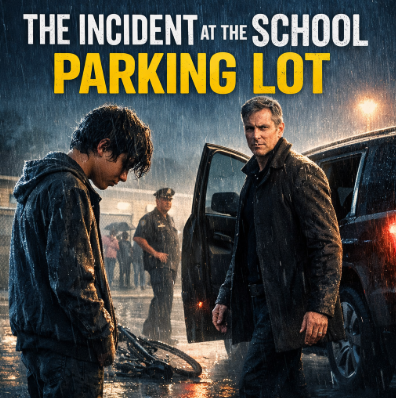
Near the edge of the lot, under a flickering streetlight, a boy knelt in the puddles beside a broken bicycle, his fingers red and shaking as he tried to push a slipped chain back into place.
His name was Ethan. He was fifteen. And that bike was the only way he got home.
The rear tire was bent, the chain rusted, and the brake cable hung loose like a snapped vein. Ethan’s hoodie was thin, its sleeves too short, darkened by rain. Every few seconds, he wiped his face with the back of his hand, not because of the rain—but because he didn’t want anyone to see his eyes.
The school behind him loomed tall and bright, windows glowing warm. Parents loaded their kids into SUVs and sedans, engines humming, doors slamming shut. Laughter leaked out of cracked windows. No one looked his way for more than a second.
Except one man.
A tall, broad-shouldered school security guard strode across the lot, boots splashing through puddles. His uniform was spotless, his jaw tight with irritation.
“Hey!” the guard barked.
Ethan flinched but didn’t look up. He knew that voice. He’d heard it before.
The guard stopped in front of him, blocking the weak light from the streetlamp. “I said, get off this property.”
“I—I’m just fixing my bike,” Ethan said quietly. His voice was almost lost in the rain.
The guard scoffed. “This isn’t a repair shop. You don’t belong here.”
Ethan swallowed. “My sister goes to school here. I was just waiting—”
Before he could finish, the guard lifted his boot and kicked the bicycle.
The metal frame scraped loudly as it slid across the wet asphalt and landed in a puddle. Mud splashed up, soaking Ethan’s jeans.
A few parents paused. A couple of students slowed their steps. Phones stayed in pockets. Eyes turned away.
Ethan stared at the bike, his shoulders hunched. Rain dripped from his hair, down his nose, onto the ground. He didn’t cry. He didn’t argue. He just stood there, silent, embarrassment burning hotter than anger.
That’s when the sound changed.
A deep, smooth engine rolled into the parking lot.
A black SUV—clean, understated, expensive in a way that didn’t need to show off—pulled in slowly and stopped a few yards away. Its headlights cut through the rain, casting long shadows across the scene.
The guard glanced over, instantly straightening his posture.
The back door of the SUV opened.
A man stepped out.
He was in his late forties, tall, with silver threaded through his dark hair. He wore a simple coat—no logos, no flashy accessories—but he carried himself with quiet confidence, the kind that didn’t need to raise its voice to be heard.
He looked first at the boy.
Then at the bicycle in the puddle.
Then at the guard.
The rain seemed to slow.
Ethan slowly straightened his back, unsure why his chest felt suddenly tight. He didn’t know who the man was. He just knew the way the guard’s face had changed—how the anger had drained out, replaced by something close to unease.
The man walked forward, shoes splashing softly.
“What’s going on here?” he asked calmly.
The guard cleared his throat. “Sir, this kid was trespassing. I was just doing my job.”
The man’s eyes never left Ethan. “Is that so?”
Ethan hesitated, then spoke, voice trembling but steady. “I wasn’t trespassing. I was waiting for my sister. Her bus was late. My bike broke.”
The man nodded slowly, then turned to the guard. “And your solution was to kick his bike into a puddle?”
The guard shifted his weight. “He shouldn’t be here. School policy—”
“School policy,” the man repeated, quietly. Then he reached into his coat pocket and pulled out his phone. He tapped the screen once.
Within seconds, another car pulled into the lot. Then another.
A woman stepped out of the first, holding a folder. A man in a suit followed from the second.
The guard’s face went pale.
The man finally looked directly at him. “Let me introduce myself. My name is Michael Carter. I’m on the board of trustees for this district.”
A murmur rippled through the nearby parents.
Michael continued, his voice even. “And that boy you just humiliated?” He gestured toward Ethan. “He’s my nephew.”
The guard opened his mouth. No sound came out.
Ethan’s eyes widened. “Uncle Mike?”
Michael glanced at him, a faint, reassuring smile appearing for the first time. “Hey, kiddo. Sorry I’m late.”
The rain kept falling, but the air felt different now—heavier, charged.
Michael turned back to the guard. “I was on my way to pick up my niece when I saw you from the entrance. I watched the whole thing.”
The guard stammered. “Sir, I—I didn’t know—”
“That’s the problem,” Michael said softly. “You didn’t know. And you didn’t care to find out.”
Parents were openly watching now. Phones were out. The silence was thick.
Michael crouched down and picked up the bicycle himself, setting it upright. He examined the bent wheel, the broken brake.
“This bike is how he gets home,” he said. “Rain or shine.”
He stood, rain soaking into his coat. “You kicked it. Why?”
The guard’s voice was barely audible. “I thought he was… trouble.”
Michael nodded once. “You thought wrong.”
He turned to the woman with the folder. “Please document this. Full report. Including witness statements.”
The woman nodded.
Michael then faced Ethan. “You okay?”
Ethan nodded, throat tight. “Yes, sir.”
Michael put a hand on his shoulder. “You did nothing wrong.”
Then, louder, for everyone to hear: “No kid should be treated like this for being poor. Or quiet. Or alone.”
A few parents shifted uncomfortably. One mother lowered her head.
Michael looked around the lot. “If any of you wondered whether you should’ve spoken up—this is your answer.”
The rain continued to pour as the guard was quietly escorted away.
Michael opened the SUV door. “Come on. Let’s get you warm. We’ll fix the bike tomorrow. Tonight, you’re riding home.”
Ethan hesitated, then picked up the bike and walked toward the car. As he climbed inside, he looked back at the school—the lights, the fence, the puddle where his bike had fallen.
For the first time that evening, he didn’t feel small.
And as the SUV pulled away, the streetlights reflected off the wet pavement, illuminating a truth everyone there would remember:
They thought he was just another poor kid.
They had no idea who was about to step in.