Three years earlier, Daniel hadn’t been blind.
He’d been a bus driver in San Antonio. Ordinary life. Long hours. Modest pay. A wife who left too early and a faith he barely remembered how to practice.
Most days blurred together. Wake up before sunrise. Coffee that tasted like regret. Routes he could drive with his eyes closed—ironic, in a way, considering what the future had planned for him. Daniel wasn’t unhappy, exactly. He was just… existing.
Faith had once mattered to him. Sundays with his mother. Church bells. Quiet prayers before sleep. But adulthood had a way of pushing God into the background, replacing Him with schedules, bills, and exhaustion.
Then came the night everything changed.
It was raining hard—one of those Texas storms that swallowed headlights and turned streets into mirrors. Traffic slowed near a broken intersection where the signal hadn’t worked for weeks. Drivers honked. Engines roared impatiently.
Daniel noticed something no one else did.
A small shape in the road.
At first, he thought it was debris. Then it moved.
A child.
She stood frozen between lanes, soaked, trembling, her pink backpack lying several feet away. Cars swerved around her, horns screaming, no one stopping.
Daniel’s heart slammed into his ribs.
He didn’t think.
He slammed the brakes, threw open the bus door, and ran into the rain.
“Hey!” he shouted. “It’s okay—come here!”
She didn’t move.
The sound came next.
A truck skidding.
Metal screaming against wet asphalt.
Daniel reached her and shoved her with everything he had. She fell safely toward the curb.
The impact hit him a heartbeat later.
Glass exploded. Pain swallowed the world.
Then—nothing.
When Daniel woke up, there was no light.
At first, he thought he hadn’t opened his eyes. He tried again. And again.
Darkness.
Voices floated around him, muffled and distant. Machines beeped. Someone said his name.
“Mr. Reyes… can you hear me?”
Panic surged. He tried to sit up, but strong hands gently pushed him back.
The doctor’s voice was careful. Too careful.
“The glass caused severe trauma,” he said. “We did everything we could.”
Daniel waited for the rest.
“You’ve lost your vision.”
The words didn’t sink in right away. They hovered in the air, unreal.
Blind.
Both eyes.
He swallowed hard. “The girl?” he asked.
A pause.
“She survived. Not a scratch.”
Relief washed over him—heavy and strange.
“Then it was worth it,” Daniel whispered.
The world didn’t slow down after that.
The city gave him a medal. The news ran his story for two days. Strangers called him a hero.
Then the calls stopped.
Bills didn’t.
His wife tried. She really did. But love became heavy when it had to guide a blind man through every doorway, every street, every silent frustration. Arguments grew. Apologies shrank.
One morning, she packed a bag.
“I can’t do this,” she cried. “I’m sorry.”
Daniel listened to the door close, memorizing the sound.
After that, the darkness felt deeper.
He learned to live without sight. Count steps. Memorize spaces. Recognize people by their footsteps. He moved into a small room near a church because it was cheap and quiet.
Every year on the same date, he walked there alone and sat in the last pew.
He never asked God for his eyes back.
He only said, “Thank You for letting her live.”
Sometimes, when the silence felt especially heavy, he added softly, “If You can still see me… that’s enough.”
Three years passed like that.
Then came the night of the dream.
Daniel slept deeper than usual. The kind of sleep that pulls you under before you realize you’re falling.
At first, there was only darkness—familiar and endless.
Then warmth.
A presence.
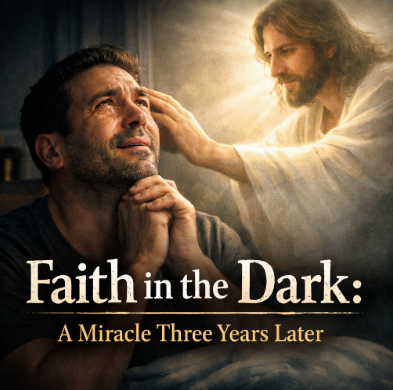
He felt a hand on his face. Gentle. Steady. Not rushed. Not uncertain.
Tears slipped from his closed eyes.
A voice spoke—not aloud, but clear enough to shake his soul.
“You lost your eyes doing good,” it said. “And good is never unseen.”
The hand moved, covering his eyes.
Light burst through the darkness.
Not harsh. Not blinding.
Alive.
Daniel woke up gasping.
He sat upright on his narrow bed, heart pounding. The dream clung to him, refusing to fade.
The room was quiet.
Then he saw the ceiling fan.
Clear. Real. Spinning slowly above him.
Daniel froze.
His hands came into view. The scar on his knuckle. The chipped paint on the wall. The thin beam of morning light slipping through the window.
“I can see,” he whispered.
His voice broke.
“I can see.”
He fell to his knees, sobbing.
“Thank you, Jesus,” he said. “Thank you.”
Doctors had no explanation.
Tests showed healed tissue where damage should have been permanent. No surgery. No medication. No gradual recovery.
Just sight.
When reporters asked how it happened, Daniel answered simply.
“He touched me.”
That evening, someone knocked on his door.
A teenage girl stood there with her mother. The same eyes. Older now—but unmistakable.
“It’s you,” she said, voice shaking. “You saved me.”
She hugged him before he could speak.
“You lost everything for me,” she whispered.
Daniel smiled through tears.
“I didn’t lose,” he said. “I was trusted.”
That night, alone again, Daniel knelt by his bed.
“I don’t know why me,” he said softly. “But I promise—I won’t waste what You gave back.”
The room felt warm.
Peaceful.
And somewhere beyond sight, Jesus listened.
Because He had known everything from the very beginning.