
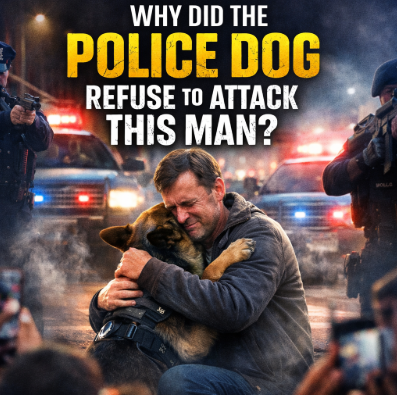
Jefferson Avenue had never been this quiet.
Not because there were no cars—there were dozens. Police cars. Black SUVs. Motorcycles angled like barricades. Red and blue lights washed over the buildings, turning glass windows into flashing warning signs.
The silence came from fear.
Everyone had stopped moving.
In the exact center of the street stood a single man.
He looked about forty. Not young. Not old. The kind of man people usually didn’t notice. Dark jacket. Faded jeans. Hands relaxed at his sides.
Too relaxed.
Officer Daniel Reyes had seen that posture before. It meant one of two things: total surrender… or total acceptance of whatever came next.
“Sir!” Reyes shouted, his voice echoing down the street. “Do not take another step.”
The man didn’t respond.
Reyes felt sweat slide down his spine despite the cold air. Twenty years in law enforcement had taught him something most civilians didn’t understand—the quiet ones were never the easy ones.
Around them, officers tightened their formation. A sniper adjusted position on a rooftop. Radios crackled.
“Background check still pending,” a voice said in Reyes’s earpiece.
“Any weapons?” Reyes asked.
“Unknown.”
Unknown was the worst answer.
A crowd had formed behind the police tape. Phones were raised. Livestreams were already rolling. Someone yelled, “What did he do?”
No one answered.
The man in the street finally lifted his head.
His eyes weren’t angry.
They weren’t scared.
They were… searching.
Like he was looking for someone.
“Sir,” Reyes said again, slower now. “Get on your knees.”
Still nothing.
That’s when the K-9 unit arrived.
The back door of the patrol SUV opened, and a German Shepherd jumped down, muscles tense, ears sharp. The dog scanned the scene in half a second, already assessing threats.
The patch on his vest read BUSTER.
Officer Mills gripped the leash tighter. “He’s locked in,” he said. “Just give the word.”
Reyes hesitated.
The man hadn’t made a single aggressive move. No reach. No run. No threat.
But command was already pushing.
“Proceed,” came the order over the radio.
Reyes swallowed. “Send him.”
Mills raised his voice, loud and final.
“Buster—GO!”
The leash snapped free.
Buster exploded forward.
People screamed.
Phones shook.
The man finally moved.
He dropped to his knees.
Not in panic.
In relief.
Buster closed the distance in seconds.
Reyes braced himself for impact.
Instead—
The dog jumped… and wrapped his front paws around the man’s shoulders.
Not an attack.
An embrace.
Buster pressed his face into the man’s neck, whining like a child who’d finally found his way home. His tail wagged uncontrollably. His body trembled.
The street froze.
No sirens.
No shouting.
Just disbelief.
“What the hell is happening?” someone whispered.
Officer Mills stared, stunned. “That’s… that’s not possible.”
The man’s shoulders shook. Tears dropped onto the pavement.
He wrapped his arms around the dog like he was holding onto the last solid thing in the world.
“He’s mine,” the man said, his voice breaking. “He’s mine.”
Reyes lowered his rifle.
Every instinct he had told him this wasn’t a threat.
This was a reunion.
Ten years earlier, Michael Carter had learned what silence really sounded like.
It wasn’t quiet.
It was the moment after an explosion, when your ears rang so badly that the world disappeared.
The convoy had been moving fast. Too fast. The road looked clear—until it wasn’t.
The blast lifted the truck and slammed it back down like a dropped toy. Fire. Dust. Screaming over the radio.
Michael hit the ground hard.
Pain came later.
First came fear.
“Buster!” he shouted, coughing dust. “Buster, come!”
Nothing.
Gunfire cracked in the distance. Someone dragged Michael by his vest.
“I need my dog!” Michael yelled. “He’s still out there!”
Hands pinned him down. A medic injected something into his arm.
“You’re not going back,” the medic said.
The last thing Michael saw before blacking out was smoke rolling across the road where Buster had been.
They told him the dog didn’t make it.
Killed in action.
Case closed.
Michael didn’t scream.
He didn’t cry.
He just went quiet.
Back on Jefferson Avenue, police finally moved.
“Stand down,” Reyes ordered into his radio. “All units. Stand down.”
They approached carefully, like the moment might shatter if they moved too fast.
“Sir,” Officer Mills said, voice cautious. “How do you know this dog?”
Michael looked up.
His face was wet with tears, but his expression was steady.
“Because he slept next to my bunk,” Michael said. “Because he learned commands in my voice. Because I carried him when he was injured.”
Mills shook his head slowly. “That dog’s been with our department for years.”
Michael nodded. “I know.”
They handcuffed him anyway.
Procedure demanded it.
Buster growled when they pulled Michael away. Not aggressive—protective.
Reyes felt a chill.
At the station, they separated them.
Buster lost control.
He barked. Pulled. Refused commands. His training unraveled like it had never existed.
“That dog has never acted like this,” Mills said quietly.
Reyes stared at the one-way glass where Michael sat alone.
“Run everything,” Reyes said. “Military records. K-9 deployments. Everything.”
Hours later, the report came back.
And that’s when Reyes realized—
Someone had lied.
Because according to the records, that dog was supposed to be dead.
END OF PART 1
Part 2
The room smelled like burnt coffee and old paperwork.
Michael sat alone at the metal table, wrists uncuffed now but still resting where the restraints had been. The interview room light hummed faintly above him. Through the one-way glass, he could sense movement—officers coming and going, voices low, tense.
Somewhere down the hall, Buster barked again.
Not angry.
Calling.
Michael closed his eyes. The sound hit him harder than the sirens had earlier. For ten years, he had trained himself not to listen for that bark. Not to turn his head when he heard paws on pavement. Not to hope.
Hope was expensive. Hope came with hospital bills, denied insurance claims, and sleepless nights that never ended.
The door opened.
Officer Reyes stepped in, holding a thick folder.
“You said your name was Michael Carter,” Reyes began, sitting across from him.
Michael nodded. “That’s right.”
Reyes opened the folder slowly, as if the papers inside might bite. “Former Army. K-9 handler. Deployed overseas. Medically discharged.”
Michael said nothing.
Reyes leaned back. “According to these records, your dog—Buster—was killed in action.”
Michael’s jaw tightened. “That’s what they told me.”
Reyes studied him carefully. “But the dog we picked up tonight? Same markings. Same microchip lineage. Same training scars.”
Michael looked up. “Then you already know the answer.”
Reyes exhaled. “I know something doesn’t add up.”
Outside the room, raised voices echoed down the hall.
“They can’t keep him separated!” someone snapped.
“That dog is losing control!”
A loud bang followed—Buster throwing his body against a kennel door.
Michael stood instinctively.
“He thinks I abandoned him,” Michael said quietly. “Again.”
Reyes hesitated only a second. “Come with me.”
They reunited in the hallway.
Buster launched himself at Michael, nearly knocking him over. Officers stepped back instinctively, hands near weapons, but the dog ignored everyone else completely.
Michael dropped to one knee, burying his face in Buster’s fur.
“It’s okay,” he whispered. “I’m here. I’ve got you.”
The dog finally settled, pressing close, as if afraid Michael might disappear again.
Every officer watching felt it.
This wasn’t a trick.
This was memory.
The internal investigation started before sunrise.
By morning, the video from Jefferson Avenue had exploded online. Millions of views. Headlines everywhere.
POLICE DOG REFUSES TO ATTACK—RECOGNIZES MAN INSTEAD
Emails flooded the department. So did calls from attorneys, veteran advocacy groups, and media outlets asking the same question:
How does a dead dog come back to life?
The official explanation unraveled fast.
Buried in archived files was a reassignment order dated two weeks after the explosion overseas. The dog had been recovered alive by a different unit, injured but responsive.
Instead of notifying Michael, command had quietly reassigned the dog.
Reason cited: handler medically unfit for redeployment.
Michael read the document twice.
Then a third time.
“They just… decided for me,” he said.
Reyes nodded. “They listed you as nonessential.”
Michael laughed softly. There was no humor in it. “He was the only thing that kept me alive out there.”
Reyes didn’t respond. He didn’t need to.
The city tried to contain the damage.
They offered Michael a private meeting. No cameras. No press. Just polished words and legal language.
A man in a suit explained things carefully—how procedures had been followed, how no harm was intended, how compensation could be discussed.
Michael listened.
Then asked one question.
“Why didn’t anyone tell me he was alive?”
The man avoided his eyes. “At the time, it was determined it would interfere with your recovery.”
Michael stood up.
“You let me grieve a living thing,” he said. “Do you know what that does to a person?”
No one answered.
That night, Michael sat alone in a guest room at a veterans’ center. Buster lay beside the bed, head resting on Michael’s boot like he used to.
Sleep didn’t come easily.
When it finally did, the dream was different.
No explosion.
No smoke.
Just a road, a leash in his hand, and Buster walking beside him—whole.
Michael woke up with tears on his face.
For the first time in years, they weren’t from fear.
By the third day, lawyers were unavoidable.
They talked about negligence. Emotional damages. Federal oversight. Potential settlements that made Michael uncomfortable just hearing the numbers.
But something else came up too.
Buster was still listed as active duty.
The department wanted him back.
Michael felt the floor drop out beneath him.
“They’re not taking him,” Michael said, voice hard.
Reyes sighed. “It’s not that simple.”
Buster, sensing the shift, growled softly.
Michael placed a hand on his back. “I lost everything once,” he said. “I’m not losing him again.”
Reyes looked at the dog. Then at Michael.
“There’s a hearing tomorrow,” Reyes said quietly. “And after what came out today… things might change.”
Michael nodded.
He knew one thing now.
This wasn’t just about a dog.
It was about the truth.
And the truth had already started barking too loud to ignore.
END OF PART 2
Read Part 3: (Part 3) Why Did the Police Dog Refuse to Attack This Man?