The school basketball court was usually loud—sneakers screeching, whistles blowing, boys shouting over each other. But that afternoon, the noise felt different. Crueler. Sharper. Like laughter with teeth.
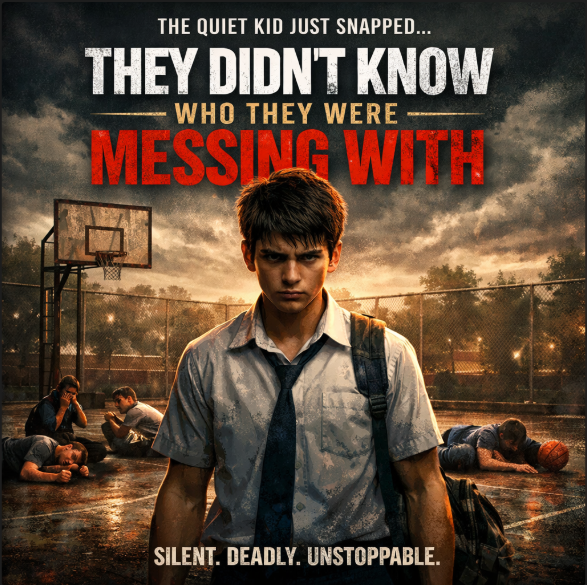
At the far end of the court, near the rusted pole holding up a bent hoop, a boy sat quietly on the cold cement floor. His school uniform was neat but old, the kind that had been worn by someone else before him. His bag lay beside him, unzipped, books half spilling out. He wasn’t crying. He wasn’t angry. He was just… still.
The others noticed that stillness.
There were five of them. Bigger boys. Louder boys. Boys who knew exactly how much space they took up in the world and enjoyed taking a little more. They had the basketball—bright orange, clean, almost new. One of them bounced it lazily, watching the quiet boy like he was something strange left behind after class.
“Why does he always sit here?” one of them said, smirking.
“Maybe he’s waiting for someone who never comes,” another replied.
They laughed.
The ball was thrown—not hard enough to be called an accident, not soft enough to be harmless. It hit the quiet boy’s shoulder and rolled away. He didn’t react. He didn’t even look up.
That made them bolder.
Another ball came, this time hitting the ground inches from his face. Dust rose into the air. The boys laughed louder now, feeding off each other’s voices, their confidence growing with every second he stayed silent.
“Hey!” one of them shouted. “You mute or something?”
“No, man,” another said. “He’s just scared.”
The quiet boy slowly picked up his fallen book and slid it back into his bag. His movements were calm, deliberate. That calmness confused them. Silence always did.
“Stand up,” one of the boys said. “Let’s see your face properly.”
For a moment, nothing happened.
Then the quiet boy placed his palms on the ground and stood up.
It wasn’t sudden. It wasn’t dramatic. It was slow—like a decision finally being made.
He brushed the dust from his uniform, straightened his collar, and lifted his head. His face held no anger. No fear. Just something steady and unreadable. His eyes met theirs, one by one, not rushing, not challenging—just seeing them.
The laughter died on its own.
No words came from him. None were needed.
Something shifted in the air.
The tallest boy frowned. “What? You gonna cry now?”
The quiet boy took one step forward.
That was all.
A strange discomfort crept in, the kind that doesn’t make sense until it’s too late. The boys exchanged glances, unsure why their jokes suddenly felt thin. The court felt smaller. The silence heavier.
In the distance, thunder rolled—low and deep.
The quiet boy moved again, this time faster. Not wild. Not reckless. Controlled.
When the first punch landed, it was clean and precise. The boy who had been laughing the loudest went down, more shocked than hurt, staring up at the sky like it had betrayed him. The others froze for a fraction of a second—just long enough to realize they had made a mistake.
What followed wasn’t chaos. It was efficiency.
The quiet boy didn’t swing wildly. He didn’t shout. He moved like someone who had learned pain the hard way and decided long ago not to waste motion. A shove here. A strike there. A step to the side. A fall. Another fall.
One of them tried to run.
The quiet boy caught him by the collar and pushed him to the ground, placing a foot beside his head—not on it. Never on it. There were lines he didn’t cross.
Within moments, the court was silent again. Five boys lay scattered across the cement, groaning, stunned, embarrassed more than injured. The basketball rolled slowly until it rested against the fence.
The quiet boy stood in the middle of it all, breathing steady.
From somewhere deep, a voice seemed to rise—not spoken by anyone there, but felt all the same. An old voice. Heavy. Worn by years and truth.
They don’t know who they’re messing with.
The quiet boy picked up his bag.
As he walked away, memories followed him like shadows.
Of a father who taught him discipline before kindness. Of long nights in a small room where silence was safer than speaking. Of learning when to endure—and when not to. Of understanding that strength didn’t always need noise.
He didn’t look back.
Behind him, the boys slowly sat up, the reality of what had happened sinking in. Not just the bruises—but the humiliation. The knowledge that they had pushed someone too far without realizing it.
Teachers would ask questions later. Stories would change. Truth would blur.
But one thing would remain clear in their minds.
The quiet boy wasn’t weak.
He never was.
He had just been waiting.