Staff Sergeant Daniel Ward had always believed some things were better left untouched—especially on old battlefields. But that belief cracked the day he found the helmet.
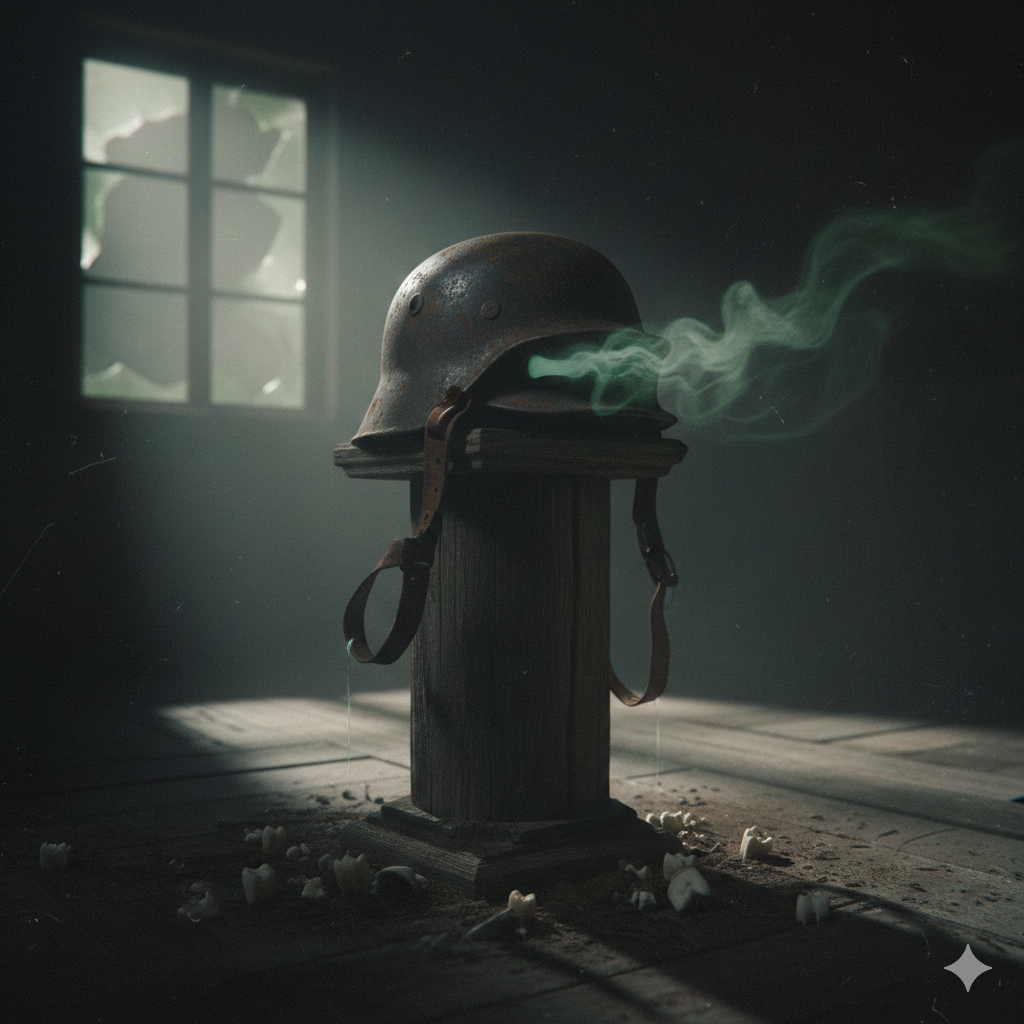
It was half-buried in the dry dirt of an abandoned training ground just outside Fort Benning. The area had once been used for simulated battle exercises during World War II, and now and then, soldiers stumbled across relics—spent rounds, rusted canteens, torn patches. But a helmet with a name still engraved inside? That felt different.
The name read: Pvt. J. Harlan.
Daniel brushed off the dust, feeling an unexpected chill crawl up his spine. He didn’t know why, but he felt drawn to it—like the metal carried a story that had been waiting decades to be heard. He slipped it into his rucksack, unaware of what he had just invited home.
Daniel lived alone in a modest two-bedroom house outside town. Being a soldier meant he spent more time away than at home, so his place was quiet—comfortably quiet. Until the first night the helmet arrived.
He placed it on his dining table after dinner, intending to clean it in the morning. But around midnight, a noise stirred him awake. At first, he thought it was the wind—or maybe the AC ducts expanding.
Then he heard it again.
A slow, deep inhale.
And an even slower, heavier exhale.
Daniel sat up straight, his heart hammering against his ribs. He wasn’t the type to scare easily—combat toughened him long ago. But there was something deeply human about that sound… something alive. It wasn’t the house settling or pipes groaning. It was breathing.
“Someone in my house?” he whispered to himself.
He grabbed his flashlight and moved cautiously toward the dining room. With each step, the breathing grew louder—like he was walking toward a sleeping person.
When he turned the corner, the beam of his flashlight stopped on the helmet.
It was tilted slightly to the side.
As if someone had just shifted inside it.
Daniel froze. His brain scrambled for logic, but instincts kept whispering something else: You shouldn’t have brought it home.
The next morning, he tried to dismiss the incident. Lack of sleep, maybe. Combat dreams. Overthinking. But as the day passed, something kept pulling him toward the helmet. He kept finding himself glancing at it, wondering… listening.
By evening, he decided to research Pvt. J. Harlan.
There were no immediate military records online. No grave sites. No archived articles. Nothing. It was like the man had never existed.
That night, Daniel fell asleep on the couch.
And the breathing returned.
This time it was louder. Closer. Almost… labored.
He opened his eyes.
The helmet was now on the floor, right beside him.
He jolted back, grabbing it and shoving it into a kitchen drawer like he was trying to trap a wild animal. The cabinet vibrated softly, like something inside was restless.
Daniel backed away, chest pounding.
“Okay… this is not normal,” he muttered.
He knew what fear felt like in war—fast, sharp, adrenaline-driven. But this was different. This was slow… creeping… like the dread was rising from the inside out.
By the fourth night, Daniel was exhausted. He hadn’t slept more than an hour. The breathing had become constant—soft during the day, louder at night. Sometimes he swore he heard whispers beneath it. A man’s voice. Broken, pleading.
He reached out to a retired historian who specialized in military artifacts. When the man arrived and saw the helmet, his expression changed instantly.
“Where did you get this?” the historian asked, his voice low.
Daniel explained.
The historian swallowed hard. “This isn’t standard-issue for WWII. It predates that.”
“Predates?” Daniel frowned. “How old is it?”
The historian traced the faded engraving with trembling fingers.
“This belongs to a soldier from World War I,” he said.
Daniel blinked. “But the training ground—”
“—was used long before WWII, too,” the historian interrupted. “Sometimes older gear was recycled. And sometimes soldiers held onto items that meant something to them.”
Daniel felt the air shift. “So who was Harlan?”
The historian hesitated. “There was a Private Joseph Harlan, age nineteen. Went missing during a night patrol. His body was never found… but his platoon reported hearing him breathing for hours after he disappeared. They searched everywhere. The sound kept coming from different directions. Then one night… it stopped.”
Daniel felt the chill hit him like cold water.
“What do I do with it?” he whispered.
The historian looked at him with a seriousness that made Daniel’s skin crawl.
“Some stories… don’t want to be remembered. Don’t keep this in your home.”
That night, Daniel drove back to the same training ground with the helmet on the passenger seat. The breathing was loud now—almost panicked, almost begging.
He placed the helmet exactly where he had found it.
And the breathing stopped.
Instantly.
The air went still, unnaturally still. Daniel stepped back, his chest tight. He didn’t wait. He drove home without looking in the rearview mirror.
He slept through the night for the first time in days.
The next morning, he returned—wanting to make sure everything was normal, wanting closure.
The helmet was gone.
Only the soft impression of where it had rested remained in the dirt.
And beside that impression… were footprints.
Fresh ones.
Leading into the trees.
And then disappearing completely.
Daniel never brought another relic home again.
Some things, he learned, are meant to stay buried—especially if they still breathe.