The first thing people noticed was the old man’s hands.
They shook—not the dramatic kind, not the kind you fake—but the quiet tremble of someone whose body had been tired longer than his mouth knew how to explain.
His knuckles were swollen, his fingernails trimmed too carefully, like someone who still believed appearances mattered even when the world stopped caring.
It was just another Tuesday afternoon on a busy American street. Horns blared. A bus hissed as it pulled away. People walked past with headphones in, eyes glued to their phones, scrolling through problems that didn’t involve this man.
And that’s how it would have stayed.
If he hadn’t spoken.
“This is wrong…” his voice cracked, thin and uneven, barely cutting through the city noise. “You can’t do this to me.”
The policeman didn’t answer right away.
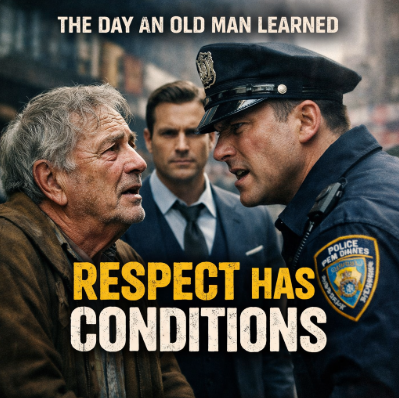
He stood tall, chest out, one hand resting near his belt, the other casually gripping a folded citation. He looked younger than the man by decades. Stronger. Louder. Protected by a badge that reflected sunlight like armor.
“What did you say?” the officer snapped.
The old man swallowed. His eyes were wet now, shining with something deeper than fear—humiliation. “I said… this is wrong. I didn’t do anything.”
A few people slowed their steps. Not enough to help. Just enough to watch.
The policeman leaned closer, invading the old man’s space, voice rising, sharp and public.
“You should know your place, old man.”
The words landed heavier than a shove.
Something broke behind the old man’s eyes. Not anger. Not defiance. Something quieter. Something final.
“I worked forty-two years,” he whispered. “I paid my taxes. I raised my kids here. I’m not asking for trouble. I’m just asking you to listen.”
The officer laughed once, short and dismissive. “You people always say that.”
The sentence hung there—unfinished, but everyone understood it.
A woman across the street stopped walking. A delivery driver leaned against his truck. Someone lifted a phone but hesitated, unsure whether this moment was worth recording or ignoring.
The officer raised his voice again, louder now, louder than necessary.
“Hands where I can see them. Now.”
The old man obeyed. Of course he did. His hands rose slowly, shaking harder this time, like he was afraid sudden movement might erase him entirely.
“I don’t understand,” he said. “Why are you treating me like this?”
Because the system didn’t owe him kindness anymore.
Because respect had an expiration date.
Because age makes people invisible until it makes them inconvenient.
That’s when the footsteps came.
Polished leather shoes. Slow. Confident. Not rushed like the rest of the street.
A man stepped into the scene like he belonged there.
He wore an expensive charcoal suit that fit perfectly, the kind you don’t buy off a rack. His watch caught the sun briefly—subtle, not flashy. He didn’t raise his voice. He didn’t rush in. He simply stood beside the old man, close enough that the officer had to acknowledge him.
“What seems to be the problem?” the man in the suit asked calmly.
The policeman turned, annoyed. “This doesn’t concern you. Step back.”
The suited man smiled—but it didn’t reach his eyes. “It does now.”
The officer straightened. He’d dealt with people like this before. Rich men. Confident men. Men who thought money could buy rules.
“Sir,” the officer said sharply, “I suggest you mind your business.”
The man in the suit tilted his head slightly, studying the badge, the name stitched above it, the patrol number on the shoulder.
Then he spoke—quietly.
“Looks like I have to teach you a lesson.”
The street went silent.
Not movie-silent. Not dramatic-silent. The kind of silence that happens when people sense something has shifted and don’t know which way it’s going to fall.
The policeman scoffed at first. He’d heard threats. Empty ones. Loud ones. Drunk ones.
But then he really looked at the man.
At how relaxed he was.
At how he didn’t raise his voice.
At how he wasn’t recording.
At how he wasn’t posturing.
At how the old man suddenly stopped shaking.
The officer’s face changed.
It wasn’t obvious at first—just a flicker. A tightening around the eyes. A pause that lasted half a second too long.
“You think you’re intimidating me?” the officer said, but the volume dropped.
The man in the suit leaned in just enough for only the officer to hear.
“My name won’t mean anything to you,” he said. “But your supervisor’s will. And his supervisor’s. And the attorney who hates surprises.”
The officer’s jaw clenched.
“I suggest,” the man continued, voice still calm, “you reconsider how you’re speaking to this man. Right now.”
A crowd had formed now. Phones were out. The officer noticed. Too late.
He glanced back at the old man—really looked at him this time. At the trembling hands. The tears he hadn’t bothered to hide anymore. The quiet dignity that had somehow survived the last five minutes.
“You okay?” the suited man asked the old man gently.
The old man nodded, though his eyes said otherwise. “I just wanted to go home.”
The policeman swallowed.
His face went pale. Not from fear of violence—but from fear of consequences. The kind that don’t fade after a shift ends.
“Sir,” the officer said stiffly, clearing his throat, “there seems to have been a misunderstanding.”
The suited man raised an eyebrow. “Funny how that happens.”
The officer lowered his voice, suddenly aware of every camera pointed at him. “You’re free to go.”
The old man didn’t move.
For a moment, no one did.
Then the suited man placed a hand lightly on the old man’s shoulder. “Let’s go,” he said.
As they walked away, the old man finally spoke again—not loudly, not for the crowd, just enough for the officer to hear.
“You didn’t have to humiliate me,” he said. “I was already old.”
The words cut deeper than any threat.
The officer stood frozen, the badge on his chest feeling heavier than it ever had. People stared. Some shook their heads. Some whispered. Some uploaded the moment to the internet where it would be argued over, edited, defended, denied.
But the truth was already done.
Because power isn’t always loud.
Because cruelty often hides behind procedure.
Because respect shouldn’t depend on who steps in to defend you.
And because somewhere in America, an old man learned that day that justice only works when someone important is watching.
The question was—
how many times had it failed when no one was?