The Warning She Ignored
The woman had learned long ago how to tune out noise.
Not just traffic. Not just people. But the other kind—the voices that lingered too long, the eyes that followed you for reasons you didn’t have time to understand. Living in a city like this trained you to move fast, think faster, and never stop for anyone who tried to slow you down.
Especially not beggars.
Her name was Marissa Cole, thirty-five years old, marketing project manager, divorced, insured up to her teeth—health, dental, life, travel, umbrella coverage.
Her life ran on calendars, reminders, and carefully calculated risk. She didn’t believe in fate. She believed in data. Probabilities. Control.
And she was already late.
The bus stop sat at the edge of Jefferson Avenue, a cracked strip of sidewalk bordered by a liquor store on one side and a closed-down medical billing office on the other.
A place people passed through, not a place anyone stayed. The city had promised redevelopment for years. For now, it remained a limbo of exhaust fumes and forgotten dreams.
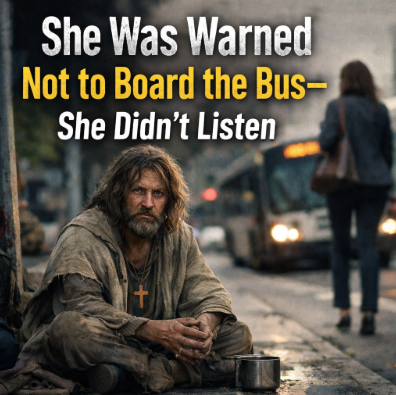
That’s where the beggar sat.
Cross-legged on a piece of cardboard, back against a rusted street sign. Her clothes were torn and sun-bleached, layers of once-white fabric now gray with dust.
The faint outline of a cross hung around her neck, carved from cheap wood, swinging gently against her chest. Her hair—long, tangled, streaked with silver—fell around her face like it hadn’t been cut in years.
But it was her eyes that stopped people.
Not wild. Not desperate.
Clear.
Marissa noticed them only because they didn’t look away.
Most beggars avoided eye contact. It was a survival tactic. This woman didn’t. She watched the world like she was waiting for something precise to happen.
Marissa adjusted her blazer and kept walking.
She had a presentation downtown in forty-five minutes. A potential client. A six-figure contract. The kind that came with bonuses, legal reviews, and clauses written by attorneys, paid more per hour than most people made in a week.
Her phone buzzed. A reminder popped up: Board Route 17 – 8:42 AM.
Right on time.
That’s when the voice cut through the noise.
“Stop.”
Not loud. Not begging.
Firm.
Marissa slowed despite herself.
“Don’t board any bus today.”
The words landed wrong. Not because they were strange—cities were full of strange—but because they weren’t dramatic. There was no trembling, no theatrical warning. Just a statement. Like someone telling you rain was coming.
Marissa turned.
The beggar was looking directly at her now.
Up close, her face was older than Marissa had guessed. Deep lines cut through her skin, but not from stress. From sun. From years outdoors. Her eyes were dark, steady, unsettlingly focused.
Marissa felt irritation rise. The familiar, practiced kind.
“Stop this,” she said sharply. “I’m not paying you anything.”
The beggar shook her head once.
“I’m not asking.”
There was a pause.
“Just don’t board the bus today.”
A city bus roared past behind them, wind whipping Marissa’s hair across her face. She scoffed.
“Yeah? And why not? Because God told you?” she snapped, instantly regretting the words but unwilling to back down.
The beggar didn’t flinch.
“Because today isn’t a good day for buses,” she said calmly.
Marissa laughed—short, dismissive.
“Right.”
She turned away, heels clicking against the concrete. She didn’t look back. She never looked back.
But she felt it.
That strange sensation between the shoulder blades. The feeling of being seen.
As she reached the bus stop bench, she glanced at her phone again. Emails stacked up. A message from her attorney about a pending settlement review. A notification from her insurance provider reminding her of a policy update she hadn’t read yet. Life marching forward in neat digital lines.
The bus horn sounded in the distance.
Route 17.
Her ride.
She exhaled, steadying herself. People were already lining up. A college kid with headphones. An older man in a mechanic’s uniform. A woman pushing a stroller.
Normal.
Predictable.
Safe.
She told herself that whatever discomfort lingered was just annoyance. Stress. Lack of sleep. She hadn’t slept well the night before. The dream had come back—the one where she stood in the middle of traffic while everyone else walked past her like she wasn’t there.
The bus pulled up with a hydraulic hiss.
Doors opened.
“Morning,” the driver muttered.
Marissa stepped forward.
For just a second—less than a heartbeat—she hesitated.
She couldn’t explain why.
The beggar’s voice echoed in her head, stripped of emotion, stripped of drama.
Don’t board any bus today.
A ridiculous warning from a woman who probably didn’t know what day it was.
Marissa stepped on anyway.
She found a seat halfway down, by the window. The bus lurched forward, pulling away from the curb. She checked her reflection in the glass, smoothing her hair, resetting her composure.
The city slid by in familiar fragments.
Storefronts. Traffic lights. Crosswalks.
The beggar disappeared from view.
Or so Marissa thought.
Three stops later, the bus slowed unexpectedly. A sudden jerk sent passengers swaying. Someone cursed under their breath.
The driver tapped the brakes harder than necessary.
Marissa frowned.
Her phone buzzed again.
This time, it wasn’t a reminder.
It was a news alert.
“Breaking: Transit Authority Investigating Safety Issue on Multiple Bus Routes.”
She swallowed.
Probably nothing, she told herself. Investigations happened all the time. Lawyers made fortunes off investigations. Insurance claims followed. Settlements were negotiated. Paperwork moved. Life continued.
Still, she couldn’t shake the tightness in her chest.
Across the aisle, the older man stared out the window, jaw clenched.
“You feel that?” he muttered to no one in particular.
“Feel what?” someone asked.
“Bus don’t feel right,” he said.
Marissa forced a smile and looked away.
She didn’t believe in signs.
She believed in contracts. In clauses. In risk assessments reviewed by professionals with law degrees and malpractice insurance.
The bus accelerated again.
Then slowed.
Then accelerated once more.
A flicker passed through the overhead lights.
Marissa’s grip tightened on her bag.
Outside, traffic thickened. Sirens wailed somewhere ahead, distant but growing louder.
Her phone vibrated again.
This time, it was a call.
Unknown number.
She ignored it.
The bus rolled forward.
Unaware.
And somewhere behind them, at the edge of Jefferson Avenue, the beggar remained seated on her cardboard square, eyes closed now, lips moving silently—whether in prayer or warning, no one could say.
Because by the time Marissa realized she should have listened…
It would already be too late.
END OF PART 1
👉 Part 2 will reveal what happens next on Route 17—and why the warning was never about faith… but about something far more calculated.
PART 2: The Route That Shouldn’t Exist
The bus shuddered again.
This time, no one pretended it was normal.
Marissa felt it in her spine first—a vibration that didn’t belong to potholes or worn suspension. It was deeper. Mechanical. Wrong. The kind of feeling you got when an elevator dropped half an inch before catching itself.
A woman near the front gasped.
“Driver?” someone called. “Is everything okay?”
The driver didn’t answer immediately. His hands tightened on the wheel. Marissa could see his jaw clench in the reflection of the overhead mirror.
“Just a sensor issue,” he said finally, too fast. “Happens sometimes.”
That word—sensor—made Marissa uneasy. She worked in risk mitigation. She knew how often “minor technical issues” showed up later in legal filings, buried under phrases like foreseeable failure and negligent maintenance.
Her phone buzzed again.
Same unknown number.
She declined the call, irritation flaring. Whoever it was could leave a voicemail.
The bus rolled into traffic, merging onto the main stretch leading toward downtown. Concrete barriers boxed them in on both sides as the road narrowed due to construction. Orange cones blurred past the windows.
The lights flickered again.
Someone laughed nervously.
“Man, this thing’s haunted.”
Marissa swallowed.
Her chest felt tight now, like she’d drunk too much coffee. She loosened her seatbelt—habit from rideshares—and stared at the scrolling LED display above the aisle.
ROUTE 17 – DOWNTOWN EXPRESS
Except the display glitched.
For half a second, the words disappeared.
Then reappeared wrong.
ROUTE 17 – NOT IN SERVICE
A murmur rippled through the bus.
“Hey, what does that mean?” the college kid asked, pulling out one earbud.
The driver cursed under his breath.
“That display’s busted,” he said. “Ignore it.”
Marissa didn’t.
Her phone vibrated again.
This time, she answered.
“Hello?”
Silence.
Then breathing.
Slow. Steady.
Not a prank. Not a recording.
A woman’s voice spoke softly.
“You boarded.”
Marissa’s stomach dropped.
“Who is this?” she demanded, lowering her voice as passengers glanced her way.
“I told you not to.”
Her mind raced. “This isn’t funny. If this is some kind of scam—”
“I don’t want your money,” the voice said. “I never did.”
Marissa’s throat went dry.
“You’re on the bus,” she whispered. “How did you get this number?”
“I’m not on the bus,” the woman replied calmly. “I’m where I’m supposed to be.”
The call ended.
Marissa stared at her phone, hands shaking. No callback option. No number. Just Unknown.
Around her, the bus grew louder. Someone argued with the driver. Another passenger stood up, trying to see out the front.
Traffic ahead had stopped completely.
Red brake lights stretched as far as Marissa could see.
Sirens screamed now—close. Too close.
The bus slowed, then stopped abruptly.
A jolt threw Marissa forward. She grabbed the seat in front of her as someone shouted in pain.
“Everybody stay seated!” the driver yelled.
Smoke drifted past the windshield.
Not engine smoke.
Something darker.
Outside, a police cruiser blocked the road at an angle. An officer waved frantically, shouting orders Marissa couldn’t hear through the glass.
The driver slammed his palm against the dashboard.
“Damn it,” he muttered.
“What’s going on?” a woman cried.
The driver hesitated, then spoke louder.
“There’s been… an incident ahead.”
“What kind of incident?” Marissa asked.
The driver met her eyes in the mirror.
“The kind they shut roads down for.”
Another bus horn blared somewhere nearby, long and panicked.
Then came the sound that made Marissa’s blood run cold.
A metal screech.
Followed by an explosion.
The force rocked their bus sideways. Windows rattled. A baby screamed. Someone fell into the aisle.
Marissa’s ears rang.
The bus jerked, then stalled completely.
The engine died.
Silence slammed down, broken only by distant sirens and the hiss of smoke.
“No, no, no,” the driver whispered, turning the key again and again. Nothing.
Marissa’s phone buzzed.
A text message this time.
You still have time.
Her heart hammered. She typed back with shaking fingers.
Time for what?
The reply came instantly.
To get off.
A police officer ran toward them, shouting through a megaphone.
“Everyone remain calm! This vehicle needs to be evacuated immediately!”
Panic erupted.
People surged toward the doors. The driver fumbled with the controls. The doors refused to open.
“They’re jammed!” he shouted.
Smoke thickened outside, seeping through cracks in the windows.
Marissa stood, clutching her bag. Her mind raced, slicing through fear with ruthless clarity.
Evacuation. Liability. Injury claims. Hospital bills. Insurance disputes. Lawsuits that would drag on for years.
But none of that mattered if she didn’t get out.
The doors finally hissed open.
People poured out, coughing, screaming, stumbling onto the road. Marissa followed, heart pounding, feet slipping on the asphalt.
As she stepped down, her phone vibrated again.
Another text.
Look left.
She did.
Across the road, beyond the police line, she saw it.
Another bus.
Crushed.
Its front end folded like paper against a concrete barrier. Windows shattered. Smoke pouring from the wreckage. Paramedics swarmed around it, stretchers already lined up.
Route number barely visible through the soot.
17.
Marissa’s knees buckled.
An officer caught her before she hit the ground.
“Ma’am, are you hurt?”
She shook her head, unable to speak.
Because she understood now.
The warning hadn’t been symbolic.
It hadn’t been religious.
It had been specific.
Don’t board any bus today.
Not just a bus.
This bus.
Her phone buzzed one last time.
Some routes repeat. Others end.
Marissa stared at the wreckage, the smoke, the flashing lights reflecting off wet pavement.
And for the first time in her life, she realized something terrifying.
Someone—or something—had known this would happen.
And the real question wasn’t how.
It was why she had been spared.
END OF PART 2
👉 Part 3 will reveal the truth behind the beggar’s warning—and the cost of ignoring it.
Part 3: (Part 3) She Was Warned Not to Board the Bus – She Didn’t Listen