I had worked the evening shift at the supermarket for almost two years, and by then I thought I had seen every kind of customer there was—impatient mothers juggling toddlers, businessmen checking their watches every five seconds, couples arguing quietly over coupons. But I had never felt as small as I did that Thursday night.
It was around 7:30 p.m., the rush hour when everyone wanted to grab dinner and get home. The fluorescent lights above aisle six flickered slightly, casting that pale glow over everything. My register beeped in its usual rhythm as I scanned groceries: bread, milk, frozen pizza, soda. I kept my smile steady. That was part of the job.
Then they walked in.
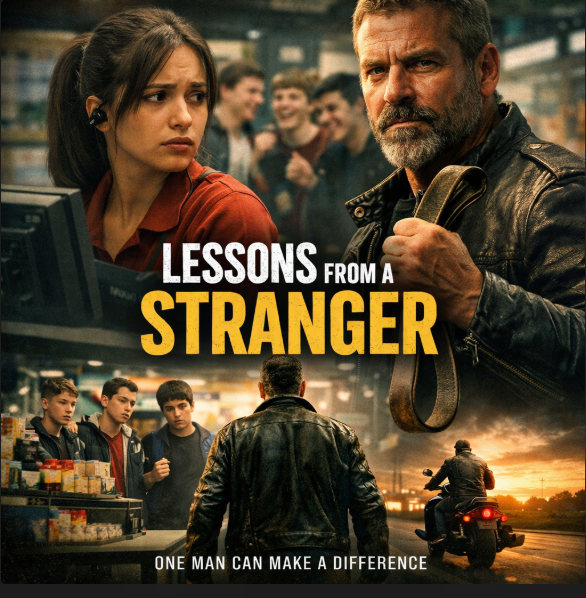
Four teenage boys, maybe sixteen or seventeen. Loud, restless energy. Hoodies half-zipped, sneakers squeaking across the polished floor. They grabbed snacks and energy drinks, laughing too hard at jokes that weren’t that funny.
They lined up at my register.
I already sensed trouble.
The first boy dumped a pile of chips and candy bars onto the conveyor belt without looking at me. The second leaned his elbows on the counter, staring at my name tag like it was entertainment.
“Go fast,” one of them muttered as I started scanning.
The barcode reader beeped.
I ignored it.
Then louder—“Do it fast, useless cashier.”
They burst into laughter.
The word useless hit harder than I expected. I had been on my feet for eight hours. My back hurt. I had skipped my break because we were short-staffed. And now this.
I kept scanning.
Beep.
Beep.
“Wow, she’s slow,” another one added. “You training or what?”
Customers in the next line glanced over but quickly looked away. Nobody wanted to get involved. That’s how it always is. People pretend not to see.
I felt my ears burning. I focused on the screen, double-checking prices so I wouldn’t make a mistake. The worst thing would be to prove them right.
“Hurry up!” the first one said again, louder this time. “We don’t got all day.”
More laughter.
I swallowed and kept my voice neutral. “Your total is $27.46.”
“Say it again,” one mocked, imitating my tone in an exaggerated, high-pitched voice. The others nearly collapsed laughing.
I felt humiliation crawling up my neck.
And then, suddenly, the laughter stopped.
Not faded—stopped.
There was a shift in the air behind them. A heavy silence that didn’t belong in a supermarket.
A deep voice spoke calmly.
“You boys done?”
The teens turned around slowly.
So did I.
He stood a few feet behind them—a tall man in a worn leather jacket, boots dusty from the road, dark beard streaked slightly with gray. He looked like someone who had lived through storms and wasn’t afraid of new ones.
A biker.
I had noticed him earlier in the store. He’d been quiet, buying only a loaf of bread and a carton of eggs.
He stepped closer.
“You think this is funny?” he asked, voice low but steady.
The boys tried to regain their bravado.
“We’re just joking, man,” one shrugged.
“Yeah,” another added, though his voice wasn’t as confident now. “It’s not serious.”
The biker tilted his head slightly. “It’s serious to her.”
For the first time since they arrived, someone acknowledged me as a person.
My hands froze above the register.
One of the boys smirked, trying to look tough. “Why you care?”
The biker’s eyes didn’t leave them. “Because someone should.”
There was no yelling. No threats. Just weight behind every word.
He slowly removed his belt—not in a violent way, but deliberately—threading it out from the loops of his jeans. The leather slid free with a soft hiss.
The gesture wasn’t about hitting anyone. It was symbolic. Old-school discipline. Authority. A reminder of consequences.
The teens noticed.
Their shoulders stiffened.
“You kids need to learn some proper etiquette,” he said.
No shouting. No cursing.
Just truth.
One of the boys looked around. Other customers were watching now. Phones subtly raised. Their laughter was gone.
“Let’s just go,” the smallest one muttered.
The loudest boy hesitated, pride fighting common sense. But even he wasn’t ready to challenge the calm intensity in front of him.
They grabbed their snacks awkwardly.
“You still gotta pay,” I said quietly, surprising even myself.
The biker didn’t look at me, but I sensed a slight approval in his posture.
The boys fumbled with a card, paid without another word, and left quickly, their earlier swagger completely drained.
The automatic doors slid shut behind them.
Silence.
Then the supermarket noise slowly returned—the hum of refrigerators, distant cart wheels, quiet conversations.
The biker placed his bread and eggs on the counter.
My hands were shaking slightly as I scanned his items.
“Thank you,” I whispered.
He shrugged. “No one deserves that.”
I looked up at him properly for the first time. His face wasn’t angry. It wasn’t even aggressive. It was tired. But kind.
“People don’t usually step in,” I said.
“They should,” he replied simply.
His total came to $6.89.
He handed me cash. Exact change.
As I gave him the receipt, I added, “You didn’t have to do that.”
He paused for a moment.
“Yeah,” he said softly. “I did.”
He walked out.
Through the glass doors, I saw a black motorcycle parked near the entrance. He put his helmet on, started the engine, and rode off into the evening.
I didn’t know his name.
But I would never forget him.
The next day, something felt different.
Not in the store—but in me.
When customers grew impatient, I didn’t shrink the way I used to. When someone sighed dramatically because I double-checked a coupon, I held my ground.
Because someone had reminded me I wasn’t invisible.
A week later, something unexpected happened.
The same group of boys came back.
My heart dropped when I saw them.
But they weren’t laughing.
They lined up quietly at my register.
The loudest one stepped forward, not meeting my eyes.
“Sorry about last time,” he muttered.
The other three shifted awkwardly.
I blinked. “Okay.”
He scratched the back of his neck. “That guy… he talked to us outside.”
My stomach tightened slightly. “Talked?”
“Yeah,” the boy said. “Didn’t touch us. Just… talked.”
“What did he say?”
They exchanged looks.
“He said disrespect starts small. And if we don’t fix it now, we grow up into men nobody respects.”
Silence filled the space between us.
“He said real strength isn’t picking on someone who can’t fight back.”
The words sounded exactly like something that man would say.
“We didn’t think about it like that,” the boy admitted.
For the first time, I saw them as kids. Not bullies. Just immature.
“Well,” I said gently, scanning their drinks, “thank you for apologizing.”
They nodded.
No laughter. No mocking.
Just four teenagers trying to correct themselves.
After they left, my manager approached me.
“I heard about last week,” she said. “Why didn’t you tell me?”
I shrugged. “Didn’t think it would matter.”
“It does,” she replied firmly. “You matter.”
Funny how sometimes it takes strangers to remind you of that.
Months passed.
I never saw the biker again.
But sometimes, on quiet evenings when the automatic doors slid open and the wind carried the faint sound of a motorcycle in the distance, I would look up, half-expecting him to walk in.
He never did.
Still, he changed something permanent.
I enrolled in night classes. Business administration. I started standing straighter. Speaking clearer.
I realized something important.
That night wasn’t about a belt.
It wasn’t about intimidation.
It was about someone choosing to step forward instead of looking away.
Courage doesn’t always shout.
Sometimes it speaks calmly in a supermarket aisle and reminds a group of teenagers—and a tired cashier—that respect isn’t optional.
It’s learned.
And sometimes, it only takes one stranger to teach it.