At 34,000 feet, panic doesn’t scream at first.
It whispers.
It starts as a strange silence between engine hums, a pause that feels wrong. The seatbelt sign clicks on—not urgent, not dramatic—just enough to make people look up from their phones.
Then someone gasps.
Row 18, aisle seat.
A middle-aged man in a gray business jacket slumps forward, his forehead resting against the tray table. His coffee spills, creeping toward the edge like it’s searching for help.
“Sir?” a woman beside him asks.
No response.
That’s when the whisper turns into fear.
A flight attendant—Emily, badge clipped slightly crooked—rushes down the aisle. She kneels, checks his pulse, presses two fingers against his neck, then his wrist. Her training kicks in, but her face betrays her.
Weak.
Irregular.
Fading.
The cabin feels smaller now. Too tight. Too close.
Emily straightens up, gripping the armrest as the plane jolts lightly.
Her voice cracks—not from lack of confidence, but from the weight of responsibility.
“Is there any doctor on this flight?” she calls out.
Heads turn. People scan faces, hoping someone else will stand up.
“This is a life-or-death situation,” she adds, louder now.
A baby starts crying.
Someone mutters a prayer.
A businessman loosens his tie like it’s choking him.
Nothing.
No one moves.
Emily’s chest tightens. She presses the call button on her wrist, speaking rapidly to the cockpit. The captain’s voice crackles back, calm but distant.
They’re rerouting.
Nearest airport: forty minutes away.
Forty minutes might as well be forever.
She turns back to the passengers, panic barely contained.
“Please,” she says again. “If anyone has medical training—any at all—stand up.”
A beat.
Then another.
And then—
“I can help.”
The voice is small, but it cuts through the cabin like a blade.
Emily snaps her head toward the back of the plane.
A boy stands between the seats.
He’s twelve. Maybe younger. Hoodie a little too big. Sneakers scuffed. Hands shaking so badly he presses them into his pockets.
The cabin reacts instantly.
“What?”
“Is this a joke?”
“Sit down, kid.”
Emily strides toward him, adrenaline flooding her veins. She doesn’t have time for this—not now.
“This is not a game,” she snaps, louder than she intends.
“We are in a real emergency right now.”
The boy swallows.
“I know,” he says.
Emily shakes her head. “Sit down. Please. We need professionals.”
The word professionals hangs heavy.
The boy doesn’t sit.
Instead, he looks past her—toward the unconscious man.
“He’s having ventricular tachycardia,” the boy says quietly. “Or close to it.”
A ripple moves through the cabin.
Emily freezes.
“What did you say?”
The boy hesitates, then steps into the aisle. “His breathing pattern changed before he collapsed. His skin’s gray, not blue. That means his heart’s still firing—but not right.”
Emily’s heart pounds. “Who told you that?”
“My mom,” he says. “She’s a cardiologist.”
That word—cardiologist—lands hard.
A man in first class leans forward. “Is this real?”
Emily’s instincts scream no. Policies exist for a reason. Liability. Lawsuits. Careers end over mistakes made at 30,000 feet.
“This is not appropriate,” she says, trying to steady her voice. “You’re a child.”
“I know,” the boy replies. “But I’ve helped before.”
Emily laughs once, sharp and humorless. “Helped how?”
The boy reaches into his backpack and pulls out a folded card. His hands stop shaking when he holds it.
It’s laminated.
CPR & AED Certified – Pediatric Advanced Life Support Observer
The date is current.
The cabin goes silent.
Emily’s throat dries.
“You… observed?” she asks.
“My mom brings me to simulations,” he says. “I’m not allowed to touch patients. But she quizzes me. Constantly. Like—constantly.”
The plane shudders again.
Emily looks at the unconscious man. Then at the boy. Then at the faces watching her.
She’s running out of time.
“Fine,” she says, jaw clenched. “You talk. I act. You don’t touch him.”
The boy nods instantly. No argument. No ego.
“Lay him flat,” he says. “Elevate his legs. Oxygen mask—full flow.”
Emily moves fast. Too fast. Her hands fumble, but she listens.
“Check pulse again,” the boy continues. “If it drops, we’ll need the AED.”
“We?” Emily snaps.
The boy meets her eyes. “Yes.”
She doesn’t argue.
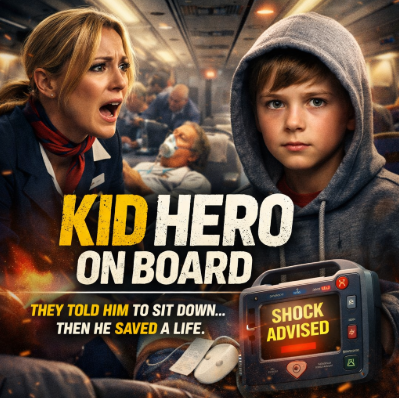
The AED comes out. The beeping fills the cabin—loud, invasive, unforgiving.
The screen flashes.
ANALYZING…
Passengers hold their breath.
NO SHOCK ADVISED.
The boy exhales. “Okay. That means we have time. Not much—but some.”
Emily looks at him, disbelief creeping in. “How do you know all this?”
He shrugs, just a kid again. “Dinner conversations.”
Minutes crawl.
The man’s pulse steadies—barely.
The captain’s voice returns. “We’re diverting. Ten minutes.”
Ten minutes might be enough.
Or not.
Suddenly, the monitor spikes.
The AED shrieks.
The boy’s voice sharpens. “Shock now.”
Emily hesitates—just a fraction.
The boy raises his voice. “NOW.”
She presses the button.
The jolt rattles the cabin.
The man gasps.
Then breathes.
Someone sobs openly. A few people clap, then stop, ashamed.
Emily sinks onto the armrest, knees weak.
The boy sits back down, heart racing, hoodie sleeves pulled over his hands like armor.
Emergency crews meet the plane on landing. The man is rushed out, alive.
Alive.
As passengers disembark, whispers follow the boy.
“Hero.”
“Just a kid.”
“Unbelievable.”
Emily stops him before he reaches the jet bridge.
“I’m sorry,” she says quietly. “For yelling.”
The boy nods. “I get it.”
She hesitates, then asks, “Why didn’t you say everything at first?”
He looks down. “Because people don’t listen to kids.”
Emily watches him walk away, realizing how close she came to making the wrong call—not because of protocol, but because of assumption.
Later that night, a headline begins circulating:
“12-Year-Old Saves Passenger Mid-Air After Being Told to Sit Down.”
By morning, it’s everywhere.
And somewhere in a hospital bed, a man opens his eyes—alive—because someone believed a kid long enough to listen.
At 34,000 feet, panic whispered.
And a child answered.