At first, people thought it was just another stop.
A man in a dark jacket was speaking to a federal agent on a busy street. Voices were raised, but that wasn’t unusual. Phones stayed in pockets. Pedestrians kept walking.
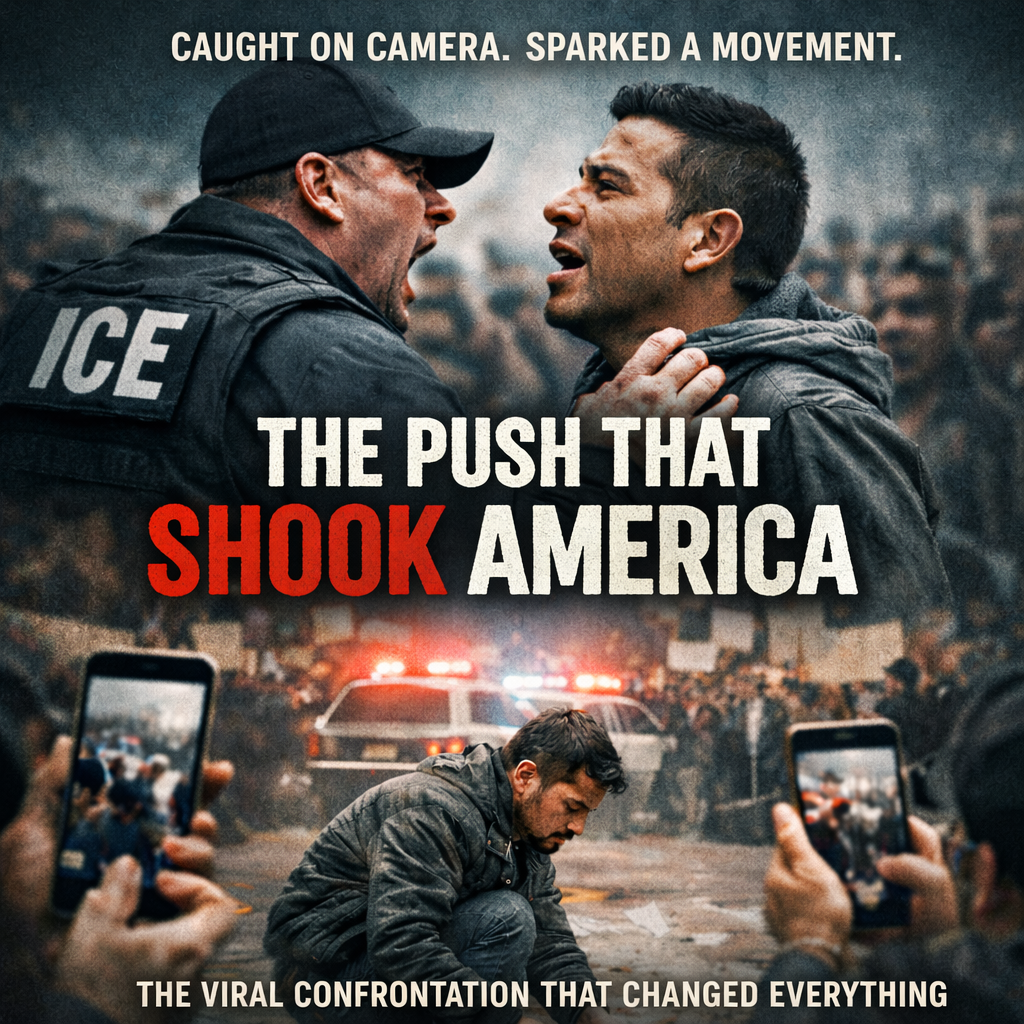
Then the agent pushed him.
The man stumbled backward, papers falling from his hands, and the sound of bodies shifting through the crowd was immediate. Someone shouted. Someone else lifted a phone. Within seconds, at least a dozen people were recording.
What happened next would be replayed millions of times—framed, paused, argued over—and would come to represent far more than a single confrontation on a city street.
Who the man was
The civilian was Luis Herrera, 32, a Venezuelan national who had entered the United States legally under a humanitarian process after leaving Venezuela in 2023. According to immigration documents later reviewed by attorneys, Herrera had a pending court date and was authorized to remain in the country while his case was processed.
Friends described him as quiet, punctual, and cautious—someone who avoided attention.
“He never argued with anyone,” said a coworker who asked not to be named. “He was scared of doing anything wrong.”
That morning, Herrera was on his way to work.
What led to the encounter
According to preliminary statements, federal agents were conducting a targeted operation in the area. Authorities have not publicly confirmed whether Herrera was part of that operation.
Video footage shows the agent asking Herrera to stop. Herrera appears to comply. He gestures toward his jacket pocket and speaks in accented English, saying he has documents.
Witnesses say the exchange escalated quickly.
“The agent kept yelling,” said Maria Collins, who recorded part of the incident. “The man was nervous, but he wasn’t aggressive.”
At one point, the agent shoved Herrera backward. The push is clearly visible in the video. What is less clear—and more debated—is what prompted it.
The moment that spread
Once Herrera was pushed, the tone of the crowd changed.
People began shouting questions. Some demanded badge numbers. Others yelled for the agent to back away. Multiple phones zoomed in as the agent continued shouting.
Herrera can be heard saying, “I’m not resisting. I’m not your enemy.”
That sentence became the headline.
By the end of the day, clips of the incident had spread across social media platforms, accumulating millions of views. Major news outlets picked up the footage within hours.
Official response
Later that evening, officials confirmed the agent had been placed on administrative leave pending an internal review. A statement said the agency was “aware of the video” and was “assessing whether proper procedures were followed.”
The statement did not address why force was used.
Herrera was briefly detained and released the following day.
No charges were filed against him.
Public reaction
Reactions were immediate and sharply divided.
Supporters of Herrera described the incident as an example of excessive force and systemic mistreatment of migrants, particularly those from countries experiencing economic and political collapse such as Venezuela.
Critics argued that the video lacked context and accused the crowd of interfering with law enforcement.
Protests were organized in several cities within 48 hours. Signs referenced the video directly. So did politicians.
“This is what unchecked power looks like,” said one lawmaker during a press briefing.
Others warned against drawing conclusions from a single clip.
The agent’s silence
The agent involved has not spoken publicly.
Sources familiar with the situation say the agent had been working extended hours amid increased enforcement pressure. Colleagues described the environment as tense.
“There’s no excuse,” said one former federal officer. “But there’s also a breaking point.”
That explanation satisfied few.
Herrera’s life afterward
For Herrera, the attention was overwhelming.
He stopped going to work for several days. Reporters waited outside his apartment. His phone filled with unknown numbers.
“I didn’t want to be famous,” he later told an attorney. “I just wanted to live quietly.”
Legal advocates took up his case, citing the video as evidence of improper treatment. Within weeks, a judge ordered a review of his immigration status.
The process is ongoing.
A familiar pattern
Advocates note that incidents involving Venezuelan migrants have increased as more people flee shortages, political instability, and violence at home. Many arrive after long journeys through multiple countries, often traumatized and deeply fearful of authorities.
“This didn’t start on that street,” said an immigration researcher. “It started years ago, in places where people had no food, no safety, and no future.”
What changed—and what didn’t
The video did not lead to sweeping reform.
It did not end aggressive enforcement.
But it did slow things down.
Internal reviews were announced. Training procedures were questioned. Court cases referenced the footage.
For Herrera, the change was smaller but personal: more time, more legal protection, and the chance to stay.
The final detail
In the original, unedited video, after the shouting fades and the crowd noise swells, Herrera bends down and gathers his papers from the pavement.
He doesn’t throw them.
He doesn’t wave them.
He folds them carefully and presses them against his chest.
For many viewers, that moment mattered more than the push.
It showed not defiance—but fear, restraint, and the simple need to prove that he belonged somewhere, at least on paper.