The emergency wing of St. Mary’s Medical Center never truly slept.
Even at midnight, the long white corridors glowed under harsh fluorescent lights, carrying the quiet chaos of life and death. Stretchers rolled past with squeaking wheels. Nurses whispered urgent updates into phones.
Somewhere in the distance, a machine beeped in a steady, mechanical rhythm — like a clock counting down invisible seconds.
In Room 417, time felt painfully slow.
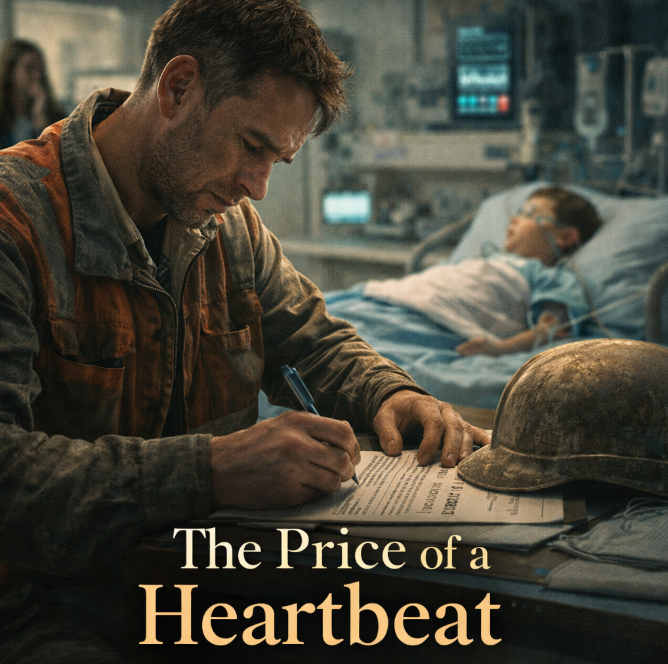
Raj Miller sat hunched beside the hospital bed, his broad shoulders slumped under exhaustion he could no longer hide. His construction uniform was still covered in dust and faint streaks of dried cement.
He hadn’t changed in days. He hadn’t even noticed.
All he could see was his son.
Eight-year-old Ethan lay surrounded by wires and tubes that seemed too large for his fragile body. The oxygen mask covered half his small face. Each breath sounded like a battle he was barely winning.
Raj reached out carefully and adjusted the blanket near Ethan’s chest. His rough hands, built for lifting steel beams and swinging heavy tools, now moved with heartbreaking gentleness.
“You remember what you promised me?” Raj whispered softly.
“You said you’d score the winning goal this summer.”
Ethan’s eyelids fluttered open. A faint, tired smile appeared.
“I still will… Dad,” he murmured weakly.
Raj forced a chuckle, though his throat burned with emotion.
“That’s my fighter.”
But the truth was crushing him.
Three surgeries in two weeks. Endless medicines. Bills stacking like walls closing in around him. He had already sold his old pickup truck. He had borrowed from coworkers who barely earned enough for themselves.
There was nothing left.
Footsteps approached outside the room — steady, formal, unavoidable.
Raj felt his stomach tighten.
The door opened.
Dr. Howard entered with the kind of expression Raj had begun to fear. It wasn’t cruel. It wasn’t even cold. It was worse — practiced sympathy.
“Mr. Miller,” the doctor said quietly.
“We need to discuss the next step.”
Raj stood up immediately, hope flickering despite everything.
“You said the infection was improving,” he replied.
“You said he just needs one more procedure.”
Dr. Howard nodded slightly.
“Yes. But the hospital requires financial authorization before we proceed.”
Raj blinked slowly.
“I don’t understand.”
The nurse beside the doctor handed him a folder thick with documents.
“Your insurance coverage has reached its limit,” the doctor explained.
“The additional treatment cost is… substantial.”
Raj’s hands trembled as he flipped through pages filled with numbers that felt unreal.
Fifty thousand.
Seventy thousand.
More.
Each digit felt like a nail sealing his child’s fate.
“So what happens if I can’t pay?” Raj asked, his voice barely audible.
The doctor paused.
“We will have to transfer him to home care.”
Raj stared at him.
“You mean… you’ll stop treating him?”
Silence answered the question.
Behind them, Ethan coughed weakly.
Raj felt something inside him crack open. He looked at his son — his entire world — and suddenly the sterile hospital walls felt like a prison.
The nurse gently placed discharge papers on the side table.
Raj picked up his dusty construction helmet and stared at it. It had protected him from falling debris countless times. It had saved his life more than once.
But tonight… it was useless.
Slowly, he signed the papers.
Each stroke of the pen felt like surrender.
“Dad…?” Ethan’s small voice floated across the room.
Raj turned quickly.
Ethan’s eyes were glossy with fear he was too young to carry.
“Are we… going home?” he asked.
“Is that good… or bad?”
Raj walked to the bed and took his son’s hand.
“It’s just temporary,” he lied softly.
“We’ll find another way.”
Ethan hesitated.
Then he whispered the words Raj would remember forever.
“Am I going home to die?”
Raj felt his knees weaken.
He lowered his head, unable to breathe through the sudden flood of pain. Tears fell onto Ethan’s blanket as he struggled to hold himself together.
Before he could answer, the door burst open.
A woman rushed inside, her heels echoing sharply against the tile floor. She wore an expensive coat, her hair slightly disheveled as though she had run all the way from the parking lot.
Behind her stood a young boy clutching her hand.
Raj looked up, confused.
The woman’s eyes locked onto him instantly.
“It’s you,” she said, her voice shaking with disbelief and gratitude.
Raj frowned.
“I’m sorry…?”
She stepped closer, tears forming.
“Three weeks ago… highway accident,” she said.
“My car flipped after a truck hit us. The doors were jammed. Smoke was everywhere.”
Memory surged back like a flash of lightning.
The smell of gasoline.
The sound of a child screaming.
Flames licking the night sky.
“You were the construction worker who stopped traffic,” she continued.
“You broke the window with your helmet and carried my son out.”
Raj glanced at the boy beside her — alive, healthy, holding a toy airplane.
He remembered now.
He had gone back twice to make sure no one else was trapped.
“I just did what anyone would,” Raj muttered.
The woman shook her head firmly.
“No. Everyone else was filming on their phones.”
Her voice broke.
“You saved his life.”
She turned toward Dr. Howard.
“Prepare the operating room immediately,” she said.
“I will take full financial responsibility for this child’s treatment.”
The doctor blinked in surprise.
Raj stared at her, stunned.
“You don’t have to do that,” he whispered.
She gently placed her hand over his.
“Tonight I do,” she replied.
“Because you didn’t ask for payment before saving my son.”
Ethan watched the exchange with wide eyes.
“Dad… does this mean I get to stay?” he asked.
Raj swallowed hard, emotion choking his voice.
“Yes, champ,” he said.
“It means you get to fight.”
The machines continued their steady beeping.
But now the sound felt less like a countdown… and more like a promise.
Outside, the rain began to slow. A faint glow of dawn crept over the city skyline.
And inside Room 417, a construction worker learned something no paycheck had ever taught him —
that sometimes the greatest wealth in the world
is the life you choose to save
without knowing who might one day save yours.