The eviction notice was already wet when Harold Whitman saw it.
Rain blurred the ink, but the words were still sharp enough to cut: FINAL NOTICE. VACATE WITHIN 72 HOURS.
After more than five decades of service, sacrifice, and silence, this was how his country chose to speak to him—through a piece of paper taped crookedly to a door.
Harold stood in the narrow hallway of Apartment 3B, listening to the rain pound the windows like distant gunfire. His hands trembled slightly as he folded the notice and slipped it into his jacket pocket. Not fear. Memory. The kind that never really leaves.
The apartment was nearly empty now. He had sold most of what he owned to pay medical bills that kept coming even after the pension checks stopped. All that remained were a few clothes, some old books, and a small wooden box sealed with faded military tape. On the nightstand sat a framed photograph—Harold in uniform, standing tall beside men who trusted him with their lives.
He turned the frame face down.
By noon, they came.
The building manager arrived first, clipboard tight against his chest, followed by a sheriff’s deputy and two movers who looked more tired than cruel. Evictions were routine. Faces blurred together. Stories didn’t matter.
“You’ve been late for months,” the manager said flatly. “We gave you extensions.”
Harold nodded. “I know.”
The deputy cleared his throat. “Any place you can go, sir?”
Harold shook his head once. “Not anymore.”
They began packing. Shirts into one box. Books into another. When one of the movers reached for the small wooden box, Harold’s voice cut through the room—low, sharp, unmistakable.
“Don’t.”
The mover froze. “Sorry,” he muttered, setting it down untouched.
No one asked what was inside.
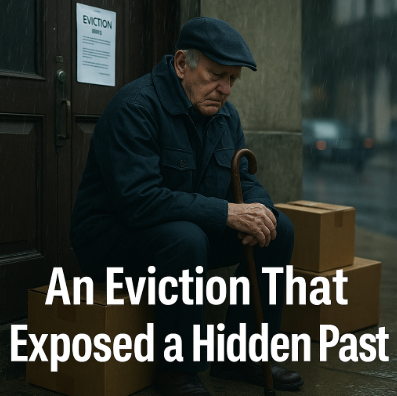
An hour later, Harold stood outside in the rain, his life stacked neatly in soggy cardboard. The door to Apartment 3B locked behind him with a final click that echoed louder than it should have. People walked past without slowing. Cars splashed water onto the curb. The city kept breathing, unaware it had just pushed one of its own out into the cold.
Harold lowered himself onto the curb, resting both hands on his cane. The rain soaked through his jacket, but he didn’t move. He had endured worse nights. Colder ones. Nights where survival meant staying awake while others slept forever.
Someone across the street raised a phone and took a picture.
That image traveled faster than Harold ever could.
By dawn, it had been shared thousands of times. “This is how we treat veterans now?” one caption read. Another said, “Evicted in the rain. Shameful.” People argued, raged, scrolled on.
But one person recognized the face.
At 6:17 a.m., three black SUVs pulled up in front of the building. Men in dark suits stepped out, scanning the area with practiced precision. The rain had slowed to a mist. Harold’s boxes still sat where he left them.
A woman with a federal badge approached the deputy on duty. He straightened immediately.
“Where is Harold Whitman?” she asked.
The deputy blinked. “The old guy? He… he left. Bench near the diner.”
They found Harold sitting exactly where the deputy said he would be. He looked up as they approached, eyes steady, unreadable.
“Took you long enough,” he said quietly.
The woman swallowed. “Sir… we didn’t know.”
Harold gave a faint smile. “You never do.”
Word spread quickly. The building manager watched from the sidewalk as conversations stopped mid-sentence and phones were silenced. He didn’t understand what was happening—only that the old man he had evicted was suddenly being treated like someone important.
The truth surfaced in fragments.
Harold Whitman wasn’t just a veteran. He had commanded a covert unit during operations that were never meant to be public. Missions that prevented wars before they started. Rescues that pulled people out of places governments denied existed. His name had been erased by design. His sacrifices filed away and forgotten.
When his body finally gave out, he didn’t complain. He didn’t ask for recognition. Paperwork vanished. Benefits were delayed. Then denied. The system moved on, as it always does.
By noon, the eviction was reversed. By evening, apologies arrived. Offers followed—housing, medical care, public recognition. Reporters waited for a statement.
Harold declined them all.
They offered him back Apartment 3B.
He looked up at the building, then down at the wet boxes. “No,” he said gently.
The woman frowned. “Sir, you deserve—”
“I didn’t serve so I could be rescued,” Harold interrupted. “I served so no one else would have to sit on that curb.”
The next week, emergency protections for veterans facing eviction were announced. Politicians stood at podiums and spoke solemnly. Headlines praised swift action.
Most people forgot soon after.
But not everyone.
Sometimes, on rainy nights, someone remembers the photo of an old man sitting quietly beside his life in boxes and wonders how many others like him are still invisible—heroes whose stories were buried, not because they weren’t important, but because they were inconvenient.
Harold Whitman never asked to be known.
He only wanted to be remembered enough not to be thrown away.