People passed that road every day without looking.
It was just another filthy corner of the city—broken pavement, overflowing garbage bags, the sour smell of rot hanging in the evening air. Flies buzzed like they owned the place. The city lights flickered awake as daylight died, bathing everything in a cold, metallic glow.
And there he sat.
The beggar.
His back was bent, spine curved as if life itself had pressed him down over the years. His clothes were torn, once grey, now stained with layers of dirt and time. His hair was matted, beard untrimmed, eyes hollow but sharp—eyes that had seen too much to ever truly go dull.
People avoided him. They always did.
Some crossed the road. Some looked away. Some tossed a coin without slowing down, as if paying a fee to escape guilt.
None of them knew who he was.
None of them knew who he had been.
A sudden screech of brakes sliced through the evening noise.
A black luxury car came to an abrupt stop beside the road—clean, polished, painfully out of place in that filth. Heads turned. A few people slowed down. Something was different.
The car door opened.
A woman stepped out.
She didn’t belong there either.
Her clothes were elegant—tailored coat, expensive shoes, hair neatly styled. But her face… her face told another story. Panic lived in her eyes. Fear. And something deeper—relief tangled with terror, like she had finally found what she’d been running from.
Her gaze locked onto the beggar.
Her breath caught.
“There you are,” she whispered, though no one heard.
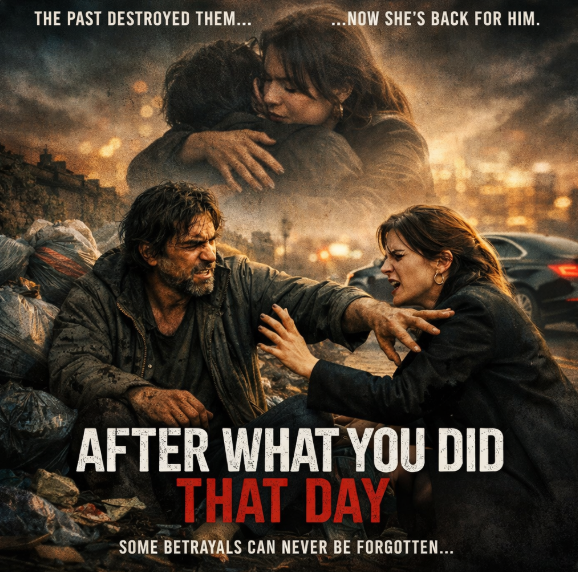
She crossed the road quickly, almost running, heels slipping slightly on the uneven surface. Garbage, flies, smell—she didn’t care. She dropped to her knees in front of him as if the world had vanished.
He looked up slowly.
For a moment, time stopped.
Their eyes met.
Recognition struck like lightning.
His jaw tightened. Her lips trembled.
“I’ve searched for you everywhere,” she said urgently, voice breaking. “Everywhere.”
She grabbed his shoulders, fingers digging into the thin fabric of his shirt, as if afraid he would disappear again. Then she pulled him into a tight hug—desperate, clinging, almost frantic.
People stared.
The beggar didn’t hug back.
His body went stiff.
Then, with sudden force, he shoved her away.
She stumbled backward, barely catching herself before falling onto the dirty pavement. Shock froze her face.
His eyes burned.
“I don’t need you anymore,” he said coldly. Then, louder, sharper, every word soaked in old pain,
“After what you did to me that day.”
Silence followed.
And with it, the past came crashing back.
Once, long ago, he had a name.
Once, he had dreams.
They had met when nothing hurt yet.
He was young then—ambitious, stubborn, full of belief. He came from nothing but refused to remain nothing. He worked two jobs, studied at night, slept four hours, and still smiled when he saw her.
She was fire and grace—intelligent, confident, born into comfort. Her family had money, influence, respect. She had choices. And she chose him.
At least, that’s what he believed.
They fell in love quietly at first—stolen moments, long conversations, promises whispered in the dark. He told her about his dreams. She told him about her fears. They planned a future that felt unbreakable.
But love is fragile when power enters the room.
Her family never accepted him.
“He’s not our kind,” they said.
“He will drag you down.”
“This is a phase.”
He knew they hated him, but he thought love would be enough.
He was wrong.
That day—the day he never forgave—started like any other.
She asked him to meet her urgently. Her voice on the phone sounded strange. Shaky.
“I need to talk to you,” she said. “Please.”
He arrived hopeful, unaware that his life was about to collapse.
She wasn’t alone.
Her father was there. Her brother. A lawyer. Two men he didn’t recognize.
The room felt cold.
They didn’t sit him down. They cornered him.
Her father spoke calmly, cruelly polite.
“You will leave my daughter,” he said. “Today.”
The beggar—then a man with dignity—laughed nervously. “Sir, we love each other.”
That was when the threats began.
False accusations. Legal cases. Job termination. His landlord suddenly wanting him out. His boss refusing his calls. Everything he had worked for—systematically dismantled.
She stood there.
Silent.
Eyes wet.
He looked at her, waiting for her to speak. To fight. To say something.
She didn’t.
Finally, her father placed papers on the table.
A confession. A signature. A statement that would destroy him if he refused.
“Sign,” the father said, “or we end you.”
He turned to her, voice breaking. “Say something. Please.”
She whispered, “I’m sorry.”
That was the moment he died.
He signed.
Within weeks, he lost everything. His job. His reputation. His friends. His future.
Depression swallowed him. Alcohol followed. Then the streets.
And she disappeared.
Now, years later, she knelt before him on a road full of garbage.
“You don’t understand,” she said desperately, tears spilling. “I was trapped. I had no choice.”
“No choice?” he laughed bitterly. “I had no choice. I lost everything.”
“I tried to find you,” she pleaded. “They kept me away. They controlled everything.”
“And now?” he snapped. “Now you’re free, so you remember me?”
Her shoulders shook. “I never forgot you.”
He stood up slowly, towering over her despite his broken body.
“Do you know what it’s like,” he said quietly, “to sleep hungry and still hear your voice? To beg strangers while remembering you lived in a mansion?”
She reached for him again.
He stepped back.
“You didn’t just leave me,” he said. “You watched me drown.”
The woman collapsed onto the pavement, sobbing openly, makeup mixing with dirt, dignity gone.
“I loved you,” she cried.
He looked at her for a long moment.
Then he turned away.
The black car waited.
So did the city.
She stayed on her knees as he walked back to his corner beside the garbage—back to the life she helped create.
But this time, he wasn’t invisible.
And this time, she would never forget him.