
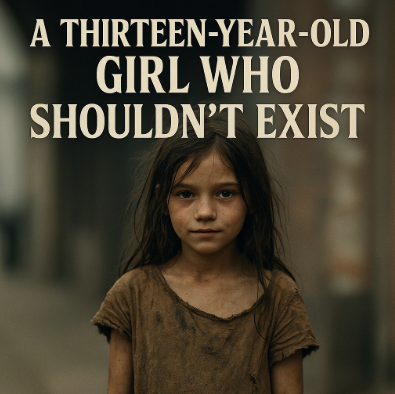
No one noticed the girl at first.
That was the strange part—she stood in the middle of a busy Chicago sidewalk, yet people moved around her as if she were a shadow. Torn brown dress hanging off one shoulder. Bare feet blackened by dust. Hair tangled and falling into her eyes. She couldn’t have been older than thirteen.
She stopped in front of a man in a wheelchair.
He was twenty-nine, though the deep lines on his face made him look older. His name was Daniel Carter, and his wheelchair sat just outside a closed deli on West Madison Street. A cardboard sign rested against the wheel:
“Disabled. Anything helps.”
Daniel had learned not to expect eye contact. Coins dropped sometimes. Food, rarely. Words—never.
So when the girl spoke, he thought he’d imagined it.
“If you give me food,” she said softly, “I can help your legs work again.”
Daniel blinked.
People said cruel things to disabled men. Sarcastic things. Pity-filled things. But never this.
He looked down at her—really looked. Her eyes weren’t wild or begging. They were calm. Steady. Almost… certain.
“Really?” he asked before he could stop himself. His voice came out hoarse. “You can do that?”
The girl smiled. Not wide. Not playful. Just a small, knowing curve of the lips.
Daniel laughed once, bitter and short. “Kid, doctors couldn’t do that.”
She tilted her head. “They didn’t listen.”
Something in the air shifted. Daniel couldn’t explain it. A chill crawled up his arms despite the warm afternoon.
He reached into his bag and pulled out half a turkey sandwich—his only meal for the day. He hesitated, then held it out.
The girl took it carefully, as if it were something sacred.
“Sit straight,” she said.
Daniel frowned. “What?”
“Please.”
Against his better judgment, he did.
The girl placed one small, dirty hand on his knee.
And then—
A sharp pain exploded through Daniel’s legs.
He gasped, gripping the wheels. “Hey—what are you—”
The girl leaned closer, whispering something he couldn’t hear. Her lips moved, but the sound was swallowed by the city noise.
Then, just as suddenly, the pain vanished.
Daniel froze.
For the first time in six years… he felt warmth.
Not numbness. Not phantom pressure.
Warmth.
His breath caught. “I—I felt something.”
The girl stepped back, already turning away.
“I’ll come back tonight,” she said. “If you still want to walk.”
And then she disappeared into the crowd.
Daniel sat there shaking, heart pounding like a drum.
Had it been hunger? Hope? A trick of the mind?
Or had something impossible just brushed against his life?
Daniel didn’t sleep.
That night, he lay in his tiny studio apartment, staring at the ceiling while rain tapped against the window. Doctors had told him he’d never walk again. A spinal injury from a freeway crash. “Permanent,” they said. “Accept it.”
He had accepted it.
Until today.
At 9:47 p.m., there was a knock at his door.
Daniel’s heart jumped. No one ever visited.
He rolled to the door and opened it.
The girl stood there, dry despite the rain. Same torn dress. Same calm eyes.
“You came,” Daniel whispered.
“You gave me food,” she replied. “That matters.”
She stepped inside, looking around the bare room. No TV. No couch. Just a mattress on the floor.
“You lost more than your legs,” she said quietly.
Daniel swallowed. “Who are you?”
She didn’t answer.
Instead, she knelt in front of him and placed both hands on his knees.
“Stand,” she said.
A bitter laugh escaped him. “I can’t.”
“You can,” she corrected. “You’re just afraid.”
Daniel closed his eyes. Fear flooded him—of falling, of failing, of believing again.
Then the pain returned.
But this time, it wasn’t sharp.
It was alive.
His toes curled.
His calves tightened.
Daniel’s eyes flew open. “Oh my God.”
“Now,” the girl said, her voice firm, almost commanding. “Stand.”
With a cry, Daniel pushed against the arms of the wheelchair.
His legs trembled violently.
Then—slowly—they held.
He stood.
For three seconds.
Then he collapsed to his knees, sobbing.
He laughed and cried at the same time, hands shaking as he touched his legs like they might disappear.
When he looked up, the girl was backing toward the door.
“Wait!” he shouted. “Don’t go. Please. Who are you?”
She paused.
“My name doesn’t matter,” she said. “What you do next does.”
And she was gone.
The next morning, Daniel walked.
Not far. Not steady. But enough.
Doctors called it a miracle. Reporters used the word unexplainable. Social media exploded.
But Daniel knew better.
He searched the streets for her.
Days passed. Then weeks.
No one had seen the girl.
Until one night, Daniel found an old newspaper clipping at the public library.
“LOCAL GIRL, 13, DIES SAVING CHILD IN HIT-AND-RUN.”
The photo made his blood run cold.
Same eyes.
Same smile.
Same torn dress.
She had died two years before Daniel’s accident.
Daniel sat back, breath stolen from his chest.
Then he noticed the article’s last line:
“Witnesses say the girl whispered something before she passed.”
Daniel closed his eyes.
He remembered the whisper he hadn’t heard.
And suddenly, he did.
“You’re not done yet.”
Daniel folded the paper and stood—strong, steady.
Outside, the city moved as always.
But somewhere, he knew, a barefoot girl was smiling.
And walking beside him.



Lueke verhalen , alleen af en toe stoppen de verhalen plots , wat wel jammer is
Thankyou
Capturing story.
Angels walk among us.