
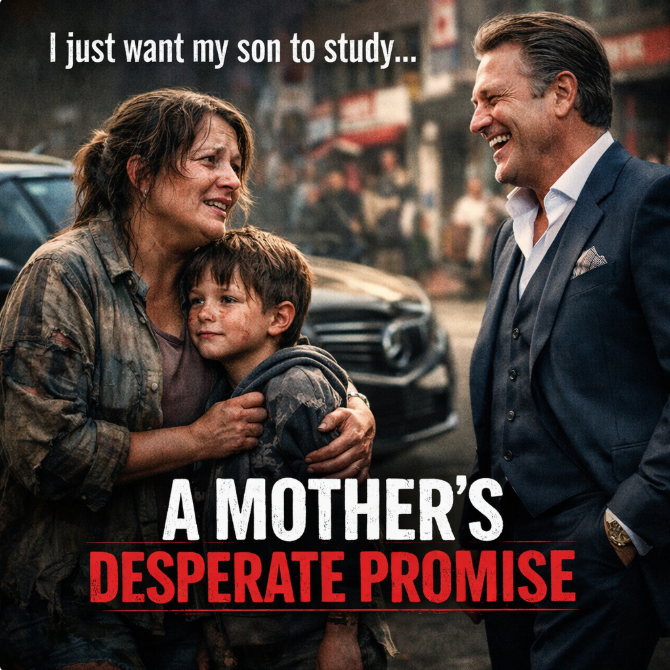
The afternoon sun hung low over a busy street in a quiet American town. Cars rolled past in steady streams, their engines humming softly while pedestrians hurried along the sidewalks.
Among the crowds, people in clean clothes carried shopping bags, checked their phones, or talked casually with friends.
Near the corner of the street stood a large black luxury car. Leaning against it was a well-dressed man in an expensive suit.
His shoes were polished, his watch glittered under the sunlight, and his expression carried the confidence of someone who had never known hardship.
Across the street, slowly walking toward him, came a woman and a small child.
The woman looked about forty-eight years old, her body heavy and tired from years of struggle. Her clothes were torn and stained with dirt. Her hair was messy, and her eyes carried deep lines of exhaustion.
Beside her walked her seven-year-old son, wearing old, oversized clothes that were ripped at the sleeves. His small hands clutched tightly to his mother’s fingers as if afraid of losing her in the crowd.
People walking past them looked away quickly, pretending not to notice.
The woman had spent the entire morning gathering courage to approach someone who looked wealthy enough to help. Her son had been asking questions again that morning—questions that broke her heart every time.
“Mom… when will I go to school like the other kids?”
She never had an answer.
They stopped in front of the rich man.
The woman hesitated for a moment, her throat dry and her heart pounding. She wiped her eyes with the back of her hand and spoke in a trembling voice.
“Sir… please listen to me.”
The man glanced at her briefly with annoyance.
“Yes? What do you want?”
Her voice cracked as tears began to roll down her cheeks.
“I want to make my son study. Please help him. I beg you. I can do anything for you.”
The man stared at her for a moment. Then suddenly he laughed.
A loud, mocking laugh that made a few people nearby turn their heads.
“Anything?” he repeated with amusement.
He slowly looked her up and down, his smile turning into something uncomfortable.
“Think again,” he said coldly. “You are beautiful. I can take advantage.”
The words hung in the air like poison.
The little boy looked confused, not fully understanding the meaning but sensing something was wrong. He tightened his grip on his mother’s hand.
The woman stood silently for a few seconds. Her face turned pale, and fresh tears rolled down her cheeks.
For a moment it looked like she might walk away.
But then she looked down at her son.
His eyes were wide and hopeful. He had heard the word “school.”
The woman closed her eyes and took a deep breath.
“I don’t care,” she whispered, her voice breaking.
“I just want my son to study in a good school.”
The rich man stopped smiling for a second, surprised by her answer. He had expected anger or insults, not quiet sacrifice.
But he quickly regained his smug expression.
“Well,” he said, shrugging slightly. “At least you’re honest.”
The boy tugged gently on his mother’s sleeve.
“Mom… what’s happening?” he asked softly.
She knelt down and hugged him tightly.
“Nothing, my child,” she whispered. “Everything will be okay.”
At that exact moment, something unexpected happened.
Across the street, a middle-aged man had been watching the entire scene. He was standing beside a small café, holding a cup of coffee in his hand. His face had grown darker with every word he heard.
He walked toward them slowly.
“Excuse me,” he said calmly.
The rich man turned.
“Yes? What is it?”
The newcomer looked directly at him.
“I heard everything you said.”
The rich man rolled his eyes.
“And?”
“And you should be ashamed.”
The rich man scoffed.
“This is none of your business.”
The stranger turned toward the woman and the child.
“Ma’am,” he said gently. “What is your son’s name?”
The boy looked up nervously.
“Daniel,” the mother replied quietly.
The man smiled kindly at the child.
“Hello, Daniel.”
Then he looked back at the woman.
“You want him to study?”
She nodded, tears still falling.
“Yes. More than anything.”
The man took out his wallet and handed her a business card.
“My name is Robert Hayes. I run a small education foundation that helps children who cannot afford school.”
The rich man’s expression changed slightly.
Robert continued speaking.
“If what you said is true, then your son deserves a chance. Not because of sacrifice or humiliation… but because every child deserves education.”
The woman stared at the card as if it were a miracle.
“Is… is this real?” she whispered.
Robert nodded.
“Come to this address tomorrow morning. We’ll arrange his school admission and support.”
The boy’s eyes widened.
“Mom… does that mean I can go to school?”
She hugged him tightly, crying harder than before—but this time with relief.
“Yes, my son. Yes.”
The rich man shifted uncomfortably beside his car.
Robert turned to him one last time.
“You have wealth,” Robert said calmly. “But today you proved that money doesn’t buy character.”
Without waiting for a response, he walked away.
The street slowly returned to its normal rhythm.
But for the woman and her son, everything had changed.
The next morning, they arrived at the address on the card—a modest office building belonging to the Hayes Education Foundation.
Within weeks, Daniel was enrolled in a local elementary school.
He received new clothes, books, and a small scholarship.
For the first time in his life, he walked through school gates with a backpack on his shoulders.
Years passed.
Daniel grew into a bright and hardworking student. Teachers quickly noticed his dedication and intelligence.
He studied harder than anyone else in his class because he never forgot where he came from—or the sacrifice his mother was willing to make for him.
His mother found work at a small community kitchen supported by the same foundation.
Life was still simple.
But it was no longer hopeless.
Fifteen years later, Daniel stood on a stage in front of hundreds of people at a university graduation ceremony.
He had just completed his degree in engineering with top honors.
In the front row sat his mother, her eyes filled with pride.
Beside her sat Robert Hayes.
When Daniel stepped to the microphone, the hall fell silent.
“I grew up on the streets,” he began.
“My mother once told a stranger she would do anything just so I could study.”
His voice shook slightly.
“But one man reminded us that dignity should never be the price of opportunity.”
He looked toward Robert and smiled.
“That act of kindness changed my life forever.”
The audience erupted into applause.
Daniel then looked at his mother.
“And my mother… she taught me the meaning of sacrifice.”
Tears streamed down her face as the crowd stood in ovation.
On that day, a story that began with humiliation on a street corner ended with hope, education, and dignity.
And the greatest victory was this:
A child who once stood in torn clothes asking for a chance had grown into a man ready to give others the same opportunity.