The photograph hit the mahogany table so hard that the crystal glasses rattled.
“WHY DO YOU HAVE MY DEAD WIFE’S PHOTOGRAPH?”
Richard Blackwood’s voice thundered through the luxurious mansion. At fifty-two, the billionaire businessman was a man accustomed to making entire boardrooms tremble with a single sentence. But tonight, his hands were shaking.
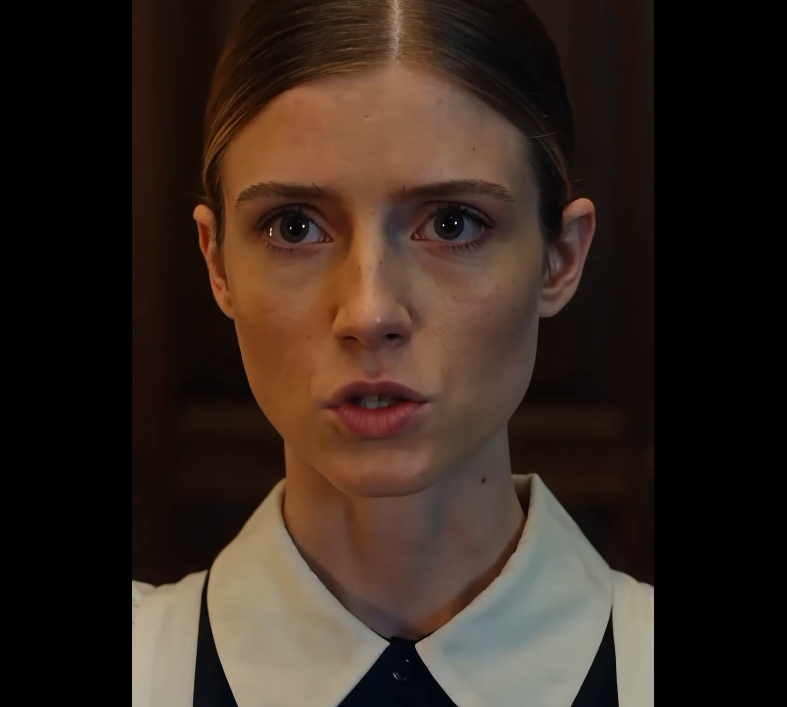
Standing before him was Emily Carter, his twenty-five-year-old maid. Her eyes were fixed on the photograph, and the moment she recognized the woman in it, all the color drained from her face.
She took a trembling step backward.
“Sir…” she whispered.
“Answer me!” Richard shouted. “I found this hidden inside your belongings. That woman is my wife, Elizabeth. She died twenty years ago. Why do you have her picture?”
Emily looked up at him through tear-filled eyes.
“Because that woman raised me.”
Richard froze.
For several seconds, the only sound in the enormous living room was the ticking of an antique clock.
Then he let out a bitter, disbelieving laugh.
“What did you just say?”
Emily swallowed painfully.
“She wasn’t the woman you think she was, sir.”
Richard’s expression hardened.
“Are you insulting my dead wife?”
“No!” Emily cried. “I’m telling you the truth. The woman in that photograph was the woman who held me when I had nightmares, who fed me when I was hungry, who stayed awake beside me when I was sick. She was the woman I called Mama.”
Richard stared at her.
“That is impossible.”
Emily lowered her eyes.
“I wish it were.”
Then she said six words that made the billionaire feel as though the floor had disappeared beneath his feet.
“She told me you were dead.”
Richard’s face went white.
Because Elizabeth had told him something almost identical on the night she disappeared.
And suddenly, a twenty-year-old mystery began to breathe again.
Twenty years earlier, Richard Blackwood had been a rising businessman, not yet the billionaire whose name appeared on skyscrapers and luxury hotels.
His wife, Elizabeth, had been the only person who could soften his relentless ambition.
She didn’t care about his expensive cars or the size of his company. She loved the man who brought her wildflowers from roadside stalls, who danced with her in their kitchen, and who promised that one day they would raise a house full of children.
Their happiness seemed complete when Elizabeth became pregnant.
But the pregnancy was difficult. Doctors warned them that complications could threaten both mother and child.
Richard begged Elizabeth to stop worrying about the company and focus on herself.
“I can lose every dollar I own,” he told her one evening, holding her hands. “But I cannot lose you.”
She smiled sadly.
“Then promise me something.”
“Anything.”
“If anything ever happens to me, don’t let our child grow up believing they weren’t wanted.”
Richard kissed her forehead.
“Nothing will happen to you. Nothing.”
He had no idea that it would become the promise he would spend the rest of his life regretting.
One rainy night, Elizabeth went into labor while Richard was away attending an important business meeting in another city.
His phone rang shortly after midnight.
By the time he reached the hospital, Elizabeth was gone.
The doctors told him that she had suffered a severe medical emergency and that neither she nor the baby had survived.
Richard refused to believe them.
He demanded to see his wife. He demanded answers. He begged the doctors to tell him where his child was.
But there was no baby to hold, no final goodbye to whisper, and no explanation that could make sense of the emptiness left behind.
He buried Elizabeth in a small cemetery overlooking the ocean.
For months, he visited her grave every Sunday.
Eventually, grief became something he buried beneath work. He expanded his company, built an empire, and filled his mansion with expensive things that could never make it feel like home.
Yet one question never left him.
Why had the hospital never allowed him to see his child?
Whenever he asked, he received the same answer: there had been complications, and the hospital had followed its procedures.
Eventually, he stopped asking.
Not because he had found peace.
Because he no longer believed the world owed him one.
Back in the mansion, Richard sat heavily in his chair.
“Where did you get that photograph?” he asked, his voice suddenly quiet.
Emily wiped her cheeks.
“It belonged to my mother.”
“Your mother?”
“The woman who raised me. Her name was Margaret.”
Richard’s eyes narrowed.
“Margaret who?”
“I never knew her last name. She told me that she had worked in a hospital when she was younger. She found me as a baby, she said. I was sick, and no one had come to claim me.”
Emily reached into the pocket of her uniform and pulled out a small, worn envelope.
“I kept this because she gave it to me on her deathbed.”
Richard didn’t move.
Emily placed the envelope beside the photograph.
Inside was a faded letter, its edges yellowed with age. The handwriting was delicate and unmistakably feminine.
Richard recognized it immediately.
It was Elizabeth’s handwriting.
His fingers trembled as he unfolded the paper.
To the woman who gives my little girl the love I cannot give her myself,
If you are reading this, I may already be gone. Please tell her that she was wanted. Tell her that I loved her before I ever saw her face.
And if the day comes when her father finds her, please make sure he understands that I never abandoned either of them.
Richard stopped breathing for a moment.
He read the final lines again and again.
I am afraid of what my husband will do when he learns the truth. He believes he can solve every problem with money and power. But this is one problem he cannot solve.
Please protect my daughter until it is safe.
Elizabeth.
Richard lowered the letter.
“What does this mean?” he whispered.
Emily shook her head.
“I don’t know everything. Mama never told me the whole story. She only said that the day I learned who my real parents were, I would understand why she kept me hidden.”
Richard looked at her face for the first time without anger.
There was something about her eyes.
The shape of them. The slight crease that appeared when she was frightened. The way she pressed her lips together when she was trying not to cry.
Elizabeth had done exactly that.
He had watched her do it thousands of times.
“Emily,” he whispered, “how old are you?”
“Twenty.”
Richard’s fingers tightened around the letter.
“Your birthday?”
“October fourteenth.”
The date struck him like a physical blow.
October fourteenth was the date Elizabeth had given birth.
Richard rose so suddenly that his chair scraped across the floor.
“No,” he murmured. “No, this cannot be happening.”
Emily began to cry.
“Sir, I didn’t come here to hurt you. I didn’t even know who you were when I applied for the job. I found the photograph in an old box after Mama died. When I saw the picture of your wife in the mansion’s hallway, I thought I was going to faint.”
Richard stared at her.
“Why didn’t you tell me?”
“Because I was afraid.”
“Of me?”
Emily hesitated.
“Of losing the only family I had left.”
Richard looked away.
For the first time in twenty years, the walls around his heart were beginning to crack.
But before he could speak, Emily reached into the envelope again.
“There is something else, sir.”
She pulled out a small brass key.
“Mama told me never to use this unless I found my real family.”
Richard looked at the key.
A memory surfaced.
Elizabeth had kept a small wooden box in her dressing room. After her death, Richard had searched the mansion for it, but it had vanished.
He had assumed it contained nothing important.
Now he wondered whether it had contained everything.
Richard led Emily upstairs to the bedroom he had barely entered since Elizabeth’s death.
Dust covered the furniture. The curtains remained drawn. On the dressing table sat a silver hairbrush and a bottle of perfume that had long since lost its fragrance.
Emily stood silently in the doorway.
“This was her room?” she asked.
Richard nodded.
“She used to sing in here.”
His voice broke on the last word.
He walked toward the dressing table and knelt beside an old cabinet. Beneath it was a narrow wooden panel he had never noticed before.
The brass key fit perfectly.
Inside was a small box containing a hospital identification bracelet, several folded documents, and a second envelope.
Richard opened the documents first.
The hospital bracelet bore the date October 14 and the name Baby Girl Blackwood.
His knees nearly buckled.
Then he opened the envelope.
The letter was addressed to him.
My darling Richard,
If you are reading this, then something has gone terribly wrong.
I need you to know that our daughter was born alive. She cried when the doctor placed her beside me. I held her for only a few minutes, but I knew I would love her for the rest of my life.
Then I heard the doctors arguing outside my room.
One of them said our daughter was not supposed to survive. Another said that a powerful man had already paid for the arrangements.
I do not know who was behind it. I only know that someone wants our daughter gone.
Margaret has promised to take her somewhere safe. I am going to make them believe that the baby died. It is the only way I know to protect her.
Please forgive me for the lie I may have to tell you.
I love you. I love our daughter.
If we are ever reunited, I pray you will have become the kind of father who can love her without trying to control her life.
Elizabeth.
Richard’s vision blurred.
He had spent twenty years believing that his daughter had died.
His daughter had been alive.
She had grown up somewhere in the world, asking questions about the people who had brought her into it. And while he built his empire, she had learned to survive without him.
“Who would do this?” he whispered.
Emily stood beside him, tears falling silently.
Richard turned toward her.
“Your mother said a powerful man had arranged it. Did she ever tell you who?”
Emily hesitated before answering.
“She said someone close to your family wanted the inheritance to remain under his control.”
Richard’s face changed.
There was only one person who had known every detail of his finances and family affairs back then.
His younger brother, Thomas.
Thomas had managed the company’s legal affairs during Richard’s early years. He had also been the only person who encouraged Richard to return to work after Elizabeth’s death.
He had told Richard that grief was a weakness and that the company needed him.
Richard had listened.
For twenty years, he had listened.
His hands curled into fists.
“Thomas,” he whispered.
Then he reached for his phone.
But Emily caught his wrist.
“Please, sir. Don’t do anything until you know the truth.”
He stared at her.
She was the daughter he had never been allowed to raise, and already she was asking him to do what he had failed to do for twenty years.
To think before acting.
Richard slowly lowered the phone.
“All right,” he said. “We’ll find out the truth together.”
The Truth That Finally Came Home
The following morning, Richard contacted a retired hospital administrator whose name appeared in the documents. After several hours of searching through archived records, she agreed to meet him privately.
The elderly woman arrived at the mansion carrying a folder.
She looked at Emily for a long time before speaking.
“I remember your mother,” she said softly. “Margaret was a nurse. She discovered that a falsified record had been entered into the maternity ward’s system.”
Richard leaned forward.
“What record?”
“The record stating that your daughter had died.”
The woman opened the folder.
“The baby had been transferred to another unit. Margaret learned that someone had ordered the transfer without proper authorization. When she questioned it, she was threatened with dismissal.”
“Who ordered it?” Richard demanded.
The administrator looked down.
“The paperwork was approved through an account associated with your brother.”
Silence swallowed the room.
Richard felt a terrible mixture of fury and relief. The truth was finally within reach, but it had come at the cost of two decades he could never recover.
“Why didn’t anyone tell me?” he asked.
The woman met his eyes.
“Margaret tried. She sent a letter to your office. It was returned to her. She believed you had chosen not to respond.”
Richard shook his head.
“I never received it.”
The administrator sighed.
“Your brother controlled the correspondence at the time. I cannot tell you exactly what happened to every document, but the records suggest that information was deliberately withheld.”
Richard closed his eyes.
Thomas had not simply stolen his daughter’s childhood.
He had allowed Richard to mourn a living child.
The evidence would need to be authenticated, and the authorities would have to determine exactly what had happened. Richard understood that a folder of old records was not the same as a complete legal case.
But it was enough to know that his brother had questions to answer.
That afternoon, Richard confronted Thomas at the family estate.
Thomas arrived smiling, expecting another discussion about the company.
Then he saw Emily standing beside Richard.
His smile disappeared.
“Who is she?” Thomas asked.
Richard placed the hospital bracelet and copies of the records on the table.
“Tell me what happened on October fourteenth.”
Thomas glanced at the documents.
For a moment, his expression revealed something that words could not hide.
Fear.
“You don’t understand what you’re looking at,” he said.
“Then explain it.”
Thomas straightened his jacket.
“Elizabeth was unstable. She was terrified of becoming a mother. I was trying to protect the family.”
Emily stepped forward.
“Protect the family from what? From me?”
Thomas looked at her with cold impatience.
“You have no idea how complicated things were.”
“No,” Emily replied, her voice trembling. “I don’t. I only know that the woman who raised me worked herself sick so I could eat. She died with one regret—that she might never see me find my family.”
Thomas looked away.
Richard slammed his palm against the table.
“Did you know my daughter was alive?”
Thomas said nothing.
“DID YOU KNOW?”
At last, Thomas whispered, “Yes.”
Richard stared at him as if he were looking at a stranger.
Thomas began to explain that he had feared the baby would change Richard’s priorities, divide the family’s assets, and weaken his influence over the company. He claimed he had acted to preserve the business and had believed Margaret would keep the child safe.
None of it changed what he had done.
“You let me bury an empty future,” Richard said, tears shining in his eyes. “You watched me visit a grave, year after year, believing my little girl was beneath it.”
Thomas reached toward him.
“Richard—”
“Don’t.”
The word was quiet, but it ended the conversation.
Richard contacted his attorneys and the authorities. The old records, Margaret’s letters, and the hospital administrator’s testimony would be examined properly.
Thomas would have to answer for his actions.
But no court could return the years he had stolen.
And no punishment could bring Elizabeth back.
That evening, Emily found Richard sitting alone in the garden.
He was holding the first letter she had shown him.
“I keep thinking about her,” he said when Emily approached. “I keep wondering what she went through after she left the hospital. Whether she cried when she had to give you away. Whether she thought I had stopped loving her.”
Emily sat beside him.
“Mama told me she cried every birthday.”
Richard pressed the letter to his chest.
“She was alive, and I wasn’t there.”
Emily took a shaky breath.
“She told me something else. She said my real father wasn’t a bad man. She said he was a good man who had been made to believe the worst thing in the world.”
Richard covered his face.
“I should have fought harder.”
“You did fight,” Emily whispered. “You just didn’t know who you were fighting for.”
He looked at her, and the tears finally came.
“I missed your first steps. Your first words. Your first day of school. I wasn’t there when you were frightened or when you needed someone to tell you everything would be all right.”
Emily began to cry too.
“I needed you.”
Richard bowed his head.
“I know.”
For a long moment, neither of them spoke.
Then Emily reached into her pocket and took out a tiny, faded photograph.
It showed a little girl sitting on an old wooden bench, smiling with two missing front teeth. Beside her sat Margaret, her arms wrapped protectively around the child.
On the back, in Margaret’s handwriting, were the words:
For my little girl. You were never unwanted. You were loved by more people than you will ever know.
Emily placed the photograph in Richard’s hand.
“She wasn’t my birth mother,” Emily whispered. “But she was my mother in every way that mattered.”
Richard looked at the picture.
“Then she was a wonderful woman.”
“She was.”
He carefully returned the photograph to Emily.
“And I owe her everything.”
Emily leaned against his shoulder.
For the first time in twenty years, Richard did not feel alone in his grief.
He felt it beside someone who understood what it meant to lose a mother, to grow up with unanswered questions, and to carry love for a family she had never known.
The following morning, Richard made a decision.
He would not ask Emily to abandon the life she had built. He would not demand that she call him Father, move into his mansion, or forgive him before she was ready.
Instead, he asked her a simple question.
“Would you have breakfast with me tomorrow?”
Emily smiled through her tears.
“Only if you promise not to shout at the maid.”
Richard laughed.
It was the first real laugh that had filled the mansion in twenty years.
“I promise.”
Then Emily hesitated.
“There’s one more thing, sir.”
Richard looked at her.
“Mama’s birthday is next week. I always visited her grave alone.”
Her voice broke.
“I don’t want to go alone this year.”
Richard reached for her hand.
“Neither of us will.”
A week later, Richard and Emily stood before Margaret’s grave beneath a clear blue sky.
Richard had brought white roses. Emily had brought the little photograph of herself and the woman who had raised her.
For a while, Richard simply stood there, struggling to find words.
Then he knelt beside the headstone.
“Margaret,” he whispered, “thank you for keeping my daughter alive. Thank you for feeding her, protecting her, and loving her when I couldn’t.”
His voice cracked.
“I cannot give you back the years you spent without help. But I promise you this: she will never have to wonder whether she belongs again.”
Emily knelt beside him.
She placed the photograph against the headstone and brushed a fallen leaf from the stone’s surface.
“Mama,” she whispered, “I found him.”
She looked at Richard and took his hand.
“And I think you would have liked him.”
Richard broke down.
Emily wrapped her arms around him, and the billionaire who had once believed that money could solve every problem cried like a man who had finally understood how little money could do.
Later that afternoon, they returned to the mansion.
Emily stopped in the hallway before Elizabeth’s portrait.
For twenty years, Richard had walked past it without allowing himself to speak to the woman he had lost.
This time, he stood beside his daughter.
“She would have loved you,” he said.
Emily studied the portrait.
“Do you think she knew we’d find each other?”
Richard considered the question.
“I think she hoped we would.”
Emily took his hand.
“Then let’s make sure she wasn’t hoping for nothing.”
That evening, Richard opened the curtains in Elizabeth’s old bedroom for the first time in twenty years. Sunlight poured across the furniture, illuminating the photographs and the little wooden box that had held the truth.
He placed Emily’s childhood photograph beside Elizabeth’s portrait.
Two generations of love, separated by a terrible lie, finally stood together.
And for the first time since his wife had died, Richard felt that his home was no longer a museum of everything he had lost.
It was a place where something beautiful could begin.
As they sat down to dinner, Emily noticed an empty chair at the table.
“Who used to sit there?” she asked.
Richard glanced at it.
“Your mother.”
Emily was quiet for a moment.
“Then maybe we should leave it empty tonight.”
Richard nodded.
They ate together, telling stories about Elizabeth and Margaret, laughing through tears and discovering the little things that connected their lives.
Before going to bed, Emily returned to the dining room.
She placed a single white rose beside Elizabeth’s photograph.
Then she whispered, “I made it home, Mama.”
From the doorway, Richard heard her.
He did not interrupt.
He simply stood there, with tears in his eyes, listening to the words his wife had waited twenty years for their daughter to say.
And somewhere between the photograph, the rose, and the quiet warmth of a home that was no longer empty, Richard finally understood the truth Elizabeth had tried to leave behind.
A child does not need a perfect family. A child needs someone who refuses to stop loving them.
Emily had been loved by a woman who gave up everything to protect her.
Richard had been loved by a woman who had trusted him to find their daughter.
And although neither of them could recover the years they had lost, they could choose what happened to the years that remained.
For the first time in two decades, Richard went to sleep without visiting Elizabeth’s grave in his dreams.
Because the little girl he had mourned was alive.
She was home.
And when Emily called him Dad for the first time the following morning, he closed his eyes and held her hand as if the world had finally given him back the one thing he had never stopped searching for.
Not his fortune.
Not his power.
Not even his past.
His daughter.