The visitation room at Red Creek County Jail was unusually quiet that afternoon.
The walls were painted a dull gray, the fluorescent lights above buzzed softly, and the thick glass partitions separated inmates from their visitors. Every few minutes, the sound of a metal door opening or closing echoed through the hallway.
Nine-year-old Noah sat beside his aunt in the waiting area, swinging his legs nervously.
He had been staring at the same spot on the floor for almost ten minutes.
His aunt gently placed a hand on his shoulder.
“She’ll be here soon.”
Noah nodded, but he didn’t answer.
His mother had been in jail for three weeks.
Three weeks since police officers had arrived at their apartment in the middle of the night.
Three weeks since his mother, Marissa, had been taken away wearing handcuffs.
And three weeks since Noah had heard the words that had changed everything.
“Your mother is being arrested.”
Noah still didn’t understand how the woman who packed his lunch every morning, helped him with homework, and kissed his forehead before bed could suddenly be called a criminal.
He knew his mother.
She wasn’t perfect.
But she wasn’t a criminal.
A heavy door opened.
A corrections officer appeared.
“Noah?”
The boy immediately stood.
“Yes.”
“Visitation room. Follow me.”
Noah grabbed his aunt’s hand.
They walked through several security doors before reaching the visitation area.
Noah’s heart began beating faster.
Then he saw her.
His mother was sitting on the other side of the thick glass.
She was wearing an orange jail jumpsuit.
Her hair was pulled back, and her eyes were red from crying.
For a moment, neither of them moved.
Then Marissa saw her son.
Her lips trembled.
“Noah…”
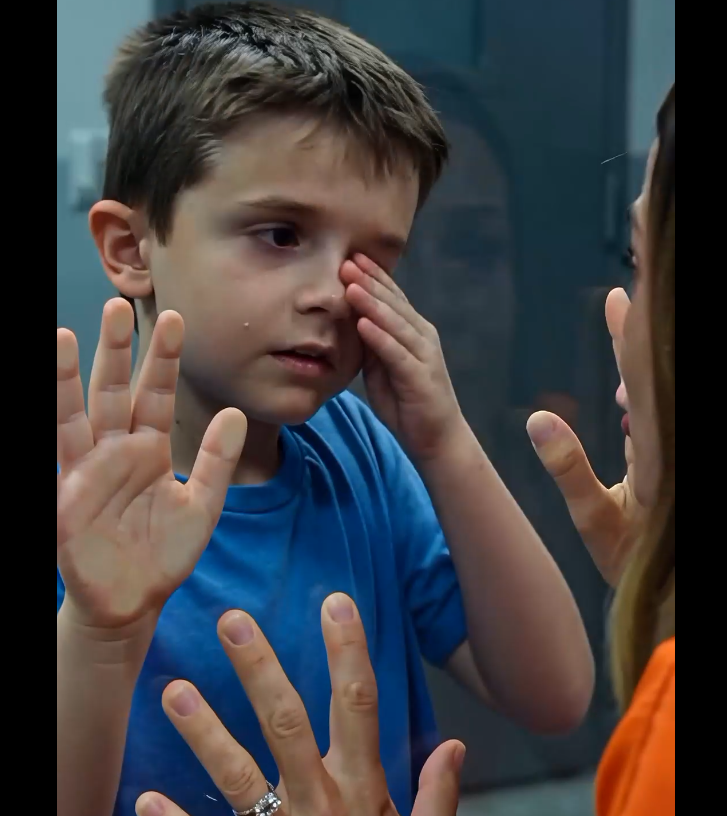
The boy rushed toward the glass.
His mother stood up and placed her palm against it.
Noah placed his hand against the other side.
Their hands lined up perfectly.
For several seconds, they simply looked at each other.
Marissa tried to smile.
But the smile quickly disappeared.
She began crying.
“Mom…”
“I’m okay, baby.”
“No, you’re not.”
Marissa shook her head.
“I don’t want you worrying about me.”
Noah’s eyes filled with tears.
“Why are you still here?”
His mother looked down.
“I told you. Everything is going to be okay.”
“But they said you stole money.”
Marissa looked at him carefully.
“I didn’t.”
“You didn’t?”
“I swear to you, Noah. I didn’t do anything wrong.”
Two security officers stood several feet behind Marissa, watching quietly.
Noah pressed his hand harder against the glass.
“Then why won’t they let you go?”
His mother’s eyes filled with tears again.
“I don’t know.”
She swallowed.
“But listen to me.”
Noah looked at her.
“Your mom is innocent, baby. I did nothing wrong.”
Noah’s expression changed.
His tears continued falling, but his voice became firm.
“I trust you, Mom.”
Marissa closed her eyes.
Then Noah whispered something that frightened her.
“I’ll make them suffer for what they did to you.”
Marissa immediately shook her head.
“No!”
Noah looked surprised.
“Mom—”
“Noah, listen to me.”
She pressed both hands against the glass.
“Don’t let anger destroy your life.”
“But they took you away!”
“I know.”
“They treated you like a criminal!”
“I know.”
“Then somebody has to pay!”
Marissa shook her head.
“No. You focus on your future.”
Noah wiped his face.
“I’ll bring you home, Mother. I promise you.”
Marissa broke down.
She placed her forehead against the glass.
“I love you so much.”
“I love you too.”
Their visitation ended fifteen minutes later.
As Noah walked away, he looked back one last time.
His mother was still standing there.
Still crying.
Still watching him.
But Noah didn’t know something important.
That night, his mother wasn’t just crying because she was in jail.
She was crying because she knew the truth was somewhere outside those walls.
And she was terrified that nobody would find it.
Three weeks earlier, Marissa had worked as an accounts manager at a small construction company called Westbridge Development.
The company had recently discovered that nearly $180,000 had disappeared from one of its business accounts.
The money had been transferred through several transactions.
And every transaction appeared to have been authorized using Marissa’s employee credentials.
The police arrested her.
Marissa insisted someone had stolen her login information.
But the evidence seemed overwhelming.
Her computer had been used.
Her password had been entered.
Her employee account had authorized the transfers.
And security footage showed Marissa entering the office late one evening.
The company’s owner, Derek Vaughn, had told investigators that Marissa was the only person with access to those accounts.
But there was one thing nobody knew.
Noah remembered that night.
He remembered his mother coming home frightened.
She had immediately checked the locks on the apartment.
She had looked out the window several times.
And when Noah asked what was wrong, she had said:
“Nothing, sweetheart. Just go to bed.”
At the time, Noah hadn’t thought much about it.
Now he couldn’t stop thinking about it.
The following Saturday, Noah visited his mother’s apartment with his aunt.
He went straight to the small desk where his mother used to work.
He opened one drawer.
Nothing.
He opened another.
Nothing.
Then he noticed an old notebook underneath several bills.
He pulled it out.
Most of the pages contained grocery lists and reminders.
But one page was different.
Written in his mother’s handwriting were several numbers.
Noah didn’t understand what they meant.
At the bottom of the page was one sentence:
“If anything happens, check the backup drive.”
Noah’s heart stopped.
Backup drive?
He searched the desk.
Nothing.
Then he remembered something.
His mother had always kept an old black storage box in the closet.
Noah found it.
Inside were old photographs, documents, and a small external hard drive.
He carried it to his aunt.
“What is this?”
His aunt looked nervous.
“I don’t know.”
“Mom said to check the backup drive.”
His aunt stared at him.
They decided to take it to a computer technician they trusted.
The drive contained hundreds of files.
Most were ordinary work documents.
But one folder was encrypted.
After several attempts, they discovered that the password was Noah’s birthday.
Inside were security recordings and copies of financial documents.
One video immediately caught their attention.
It showed the company’s office hallway on the night the money disappeared.
Marissa entered the office at 8:14 p.m.
But she wasn’t alone.
A man entered through another door twelve minutes later.
He was wearing a baseball cap.
His face wasn’t visible.
He went directly toward the server room.
Then the video froze.
Someone had deliberately deleted the next twenty minutes.
But the backup drive contained something else.
A system log.
It showed that Marissa’s account had been accessed remotely from a different computer at the exact time the transfers occurred.
Noah’s aunt immediately contacted an attorney.
The attorney studied the evidence.
“This could change everything.”
Two days later, investigators reopened the case.
They subpoenaed the company’s computer records.
The results were shocking.
Marissa’s password had been stolen weeks before the money disappeared.
The person who used it had accessed the system from a computer belonging to the company’s operations director.
His name was Calvin Reed.
Further investigation revealed that Calvin had been secretly transferring money from the company for months.
Marissa had discovered irregularities shortly before her arrest.
She had planned to report them.
That’s why Calvin had framed her.
He had used her credentials, deleted security footage, and planted evidence to make it look like she was responsible.
But he had made one mistake.
He didn’t know Marissa had automatically backed up her computer every night.
The evidence from the drive was enough.
Calvin was arrested.
The charges against Marissa were dropped.
Three days later, Noah returned to Red Creek County Jail.
This time, his mother was waiting behind the glass.
But something was different.
She was smiling.
The door opened.
Marissa walked into the visitation room.
Noah ran toward her.
They pressed their hands against the glass again.
Only this time, there were tears of happiness.
“Mom?”
“Yes, baby?”
“They’re letting you go.”
Marissa nodded.
“They finally believed me.”
Noah smiled.
“I told you I would bring you home.”
His mother laughed through her tears.
“You did.”
“No.”
She shook her head.
“You didn’t bring me home, Noah.”
She placed her hand against the glass.
“You helped me find the truth.”
Noah smiled.
“I told you I trust you.”
Marissa’s eyes filled with tears.
“And that was the most important thing.”
A few hours later, the jail doors opened.
Marissa walked outside carrying a small paper bag containing her belongings.
Noah was waiting.
The moment he saw her, he ran into her arms.
She hugged him tightly.
“I missed you.”
“I missed you too.”
Noah pulled back.
“Are you coming home?”
Marissa smiled.
“Yes, baby.”
They walked toward the car together.
Before getting inside, Noah looked back at the jail.
Three weeks earlier, he had stood behind a glass window believing his mother might never come home.
Now she was standing beside him.
Free.
His mother squeezed his hand.
“Remember what I told you?”
“What?”
“Don’t let anger control your future.”
Noah nodded.
“I remember.”
“And?”
He smiled.
“I’ll focus on my future.”
Marissa hugged him again.
“That’s my boy.”
They got into the car.
As they drove away, Noah rested his head against the window.
He had made a promise that day in the visitation room.
He had promised his mother he would bring her home.
And even though he was only nine years old, he had learned something that would stay with him for the rest of his life:
Sometimes justice doesn’t begin with revenge.
Sometimes it begins with believing the person you love when nobody else does.