The parking lot was almost empty.
Just a wide stretch of cracked concrete, a few flickering streetlights, and the echo of distant traffic humming like a tired heartbeat. Evening had settled in—not fully dark, not fully alive. The kind of hour when people hurried home and the forgotten were left behind.
Near a stained wall sat the beggar.
His wheelchair was old, its paint chipped, one wheel slightly bent. He sat quietly, hands folded in his lap, eyes fixed on the ground as if the world above him no longer existed. His clothes were torn but clean in places, washed by rain and worn by time. A thin blanket covered his legs. Every few minutes, he adjusted it, not because he was cold—but because dignity demanded small rituals.
He did not beg loudly.
He never did.
He simply existed.
That was enough to anger some people.
Footsteps echoed across the concrete—heavy, confident, careless.
The beggar felt the shadow before he looked up.
A bald man stood in front of him. Tall. Thick neck. Muscles stretched beneath a tight T-shirt. The kind of man who took pride in occupying space. The kind who believed fear was a language only he could speak.
The beggar raised his eyes slowly.
For a moment, nothing happened.
Then the bald man smirked.
“Move,” he said casually, as if talking to a broken object.
The beggar opened his mouth. “Sir… I—”
The bald man didn’t wait.
With a sharp shove, he pushed the wheelchair.
The metal screeched. The beggar lurched sideways, nearly falling onto the concrete. His hands scraped the ground. Pain shot through his wrists. The blanket slipped, exposing thin, useless legs.
The bald man burst out laughing.
A loud, ugly laugh that echoed through the empty lot.
“Look at you,” he said, pointing. “Blocking the way like you own the place.”
The beggar tried to pull himself upright. His hands trembled. He said nothing. Years had taught him that silence was safer than protest.
The bald man leaned closer. “What? Can’t stand up to say sorry?”
More laughter.
Then, suddenly—
VROOOOM.
A motorcycle engine roared in the distance.
The sound cut through the laughter like a blade.
The bald man turned his head, annoyed. “What now?”
The engine grew louder. Slower. Intentional.
A black bike rolled into the parking lot and stopped sharply a few feet away. The headlight stayed on, blinding for a second.
The rider didn’t speak.
He removed his helmet slowly.
He wasn’t huge. He wasn’t loud. But there was something about the way he stood—balanced, controlled, aware. His jacket was worn. His eyes were steady.
He looked first at the wheelchair.
Then at the beggar on the ground.
Then at the bald man.
The laughter died.
The biker walked past the bald man without acknowledging him.
He crouched beside the beggar.
“Are you hurt?” he asked quietly.
The beggar nodded, embarrassed. “It’s… it’s nothing.”
The biker shook his head slightly. “It’s never nothing.”
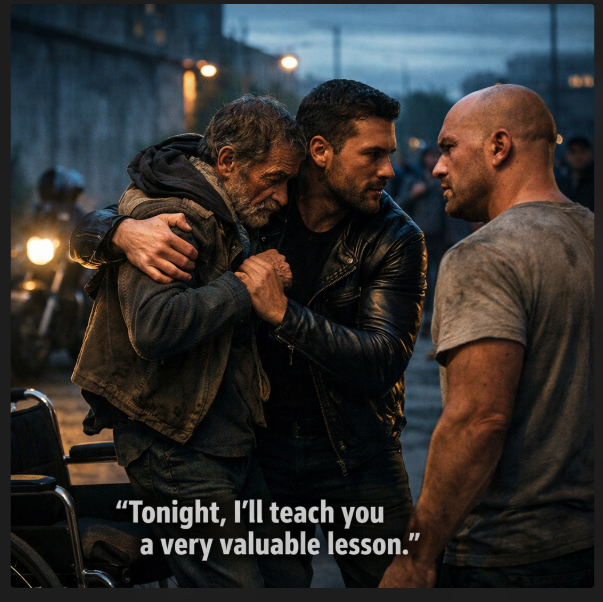
With careful hands, he helped the beggar sit upright. Then, with surprising strength and gentleness, he lifted him from the wheelchair, supporting his back, his weight, his pride.
The beggar winced. “I’m heavy—”
“You’re human,” the biker said. “That’s not heavy.”
He placed the beggar safely on a low concrete ledge and adjusted the blanket over his legs. Only then did he straighten up.
Slowly.
He turned around.
The bald man crossed his arms, forcing a grin. “What? You his bodyguard now?”
The biker stepped closer. One step. Calm. Measured.
“Did you push him?” he asked.
The bald man scoffed. “So what if I did?”
Another step.
“He’s in my way.”
The biker stopped an arm’s length away. His voice dropped—not loud, not angry. Worse.
“Tonight,” he said, eyes locked onto the bald man’s,
“I’ll teach you a very valuable lesson.”
The bald man’s smile flickered.
“Yeah?” he said, though his voice cracked slightly. “You and what army?”
The biker didn’t answer.
He simply looked at him.
And the bald man felt it—that sudden realization that he had misjudged the room. That strength wasn’t always loud. That danger didn’t always shout.
“Let’s go,” the bald man muttered, stepping back.
The biker didn’t move.
“You don’t walk away from this,” he said. “Not yet.”
People had begun to gather—two drivers, a shopkeeper from across the street, a security guard watching from a distance. Phones came out. The air grew heavy.
The biker spoke clearly now, so everyone could hear.
“You think power means pushing someone who can’t fight back. You think laughter makes you strong.”
He stepped aside, gesturing toward the beggar.
“This man lost his legs in an accident ten years ago. He worked construction. Paid taxes. Raised a daughter.”
The beggar’s eyes widened.
The biker continued, calm and precise. “You pushed him because you thought no one would stop you.”
The bald man swallowed.
“So here’s your lesson.”
The biker pulled out his phone and turned on the camera.
“You apologize,” he said, “on camera. Loud enough for everyone to hear.”
The bald man clenched his fists. His pride screamed no. His survival whispered yes.
“I said apologize,” the biker repeated.
Silence stretched.
Then—
“I’m… sorry,” the bald man muttered.
“Not to me.”
The bald man turned, jaw tight. He looked at the beggar.
“I’m sorry,” he said again, louder this time.
The biker nodded.
“And you help him back into his wheelchair,” he added.
Hands shaking, the bald man did as he was told.
When it was done, the biker ended the recording.
“That video,” he said, slipping his phone away, “will stay with me. If I ever see you again doing something like this… the next lesson won’t be verbal.”
The bald man nodded quickly and walked away without looking back.
The crowd dispersed.
The parking lot returned to silence.
The beggar looked up at the biker. “Why did you help me?”
The biker smiled faintly. “Someone once helped my father. Same way.”
He placed some money into the beggar’s hand—not charity, but respect.
Then he put on his helmet.
The engine roared again.
As the bike disappeared into the night, the beggar sat quietly—hurt, shaken, but no longer invisible.
And somewhere, a man who once laughed learned that cruelty always finds its teacher