People say cities make you cold.
That if you stare at enough suffering, you stop seeing it at all.
That afternoon, the city proved them right—until it didn’t.
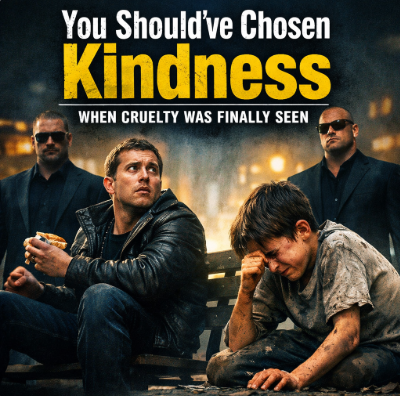
The boy appeared out of nowhere, like a ghost slipping between traffic and noise. He couldn’t have been more than twelve. His clothes hung off him as if they belonged to someone else, someone bigger, someone who once ate full meals. Dirt stained his cheeks, but his eyes were clean—too clean for a kid who lived on the streets.
He stopped in front of a man sitting on a bench.
The man was mid-bite into a burger. Thick, juicy. Extra cheese melting down the side. The smell alone could make a starving person dizzy.
The boy didn’t speak. He couldn’t.
Instead, he raised his hands and made slow, careful signs. One finger pointed to his mouth. Then to the burger. Then back to the man. His lips parted and a soft sound escaped his throat.
“Aaaa… aaa… auu…”
It wasn’t language. It was desperation.
The man frowned.
He was dressed well—clean sneakers, fitted jacket, phone buzzing beside him on the bench. The kind of guy who looked like he had somewhere better to be and no patience for interruptions.
“Hey,” the man snapped, waving his hand. “Get away.”
The boy didn’t move. He nodded quickly, trying again. His hands trembled. His stomach growled loud enough to be heard.
“Aaaa… auu…”
People walked past them. A woman glanced over, then looked away. A man pretended to take a call. No one stopped.
The man’s face twisted with irritation.
“I said stay away from me,” he barked. “You’re gonna spoil my food.”
Then he stood up and shoved the boy.
Hard.
The kid wasn’t ready. His feet slipped out from under him and he hit the pavement with a dull crack. His palms scraped against the concrete. Pain shot through his arms, but that wasn’t what broke him.
It was the look on the man’s face—disgusted, annoyed, like the boy was trash that had wandered too close.
The boy sat there, stunned. His mouth opened wide, but no scream came out. Only broken sounds and shaking breaths. Tears spilled down his cheeks as he rocked back and forth, clutching his scraped hand.
Still, no one stepped in.
The city kept moving.
That’s when the footsteps started.
Heavy. Calm. Deliberate.
The man turned, still breathing hard, ready to snap at whoever dared interrupt him next.
He froze.
Two men had stopped behind the bench.
They were tall. Broad. Dressed in dark suits that didn’t wrinkle, shoes that didn’t scuff. The kind of men who didn’t need to raise their voices because everyone already listened when they spoke.
They didn’t look angry.
They looked controlled.
One of them stepped forward just enough to block the man’s escape.
The other glanced down at the boy, still crying silently on the ground. His jaw tightened.
The man swallowed. “Uh—what’s the problem?”
No one answered at first.
The taller bodyguard bent slightly and offered the boy a hand. Gently. Like you would help your own child stand. The boy hesitated, then took it. His hands were shaking.
The bodyguard reached into his pocket and pulled out a wrapped sandwich. Fresh. Untouched. He placed it in the boy’s hands.
The kid stared at it, confused. Then his eyes filled again. He bowed his head repeatedly, hands shaking as he clutched the food.
The second bodyguard finally spoke.
His voice was low. Calm. Dangerous.
“You should’ve chosen kindness.”
The words landed heavier than a punch.
The man’s face drained of color. “I—I didn’t know,” he stammered. “He just came up to me. I didn’t mean—”
“You didn’t mean to push a starving child to the ground?” the bodyguard asked.
The man opened his mouth. Nothing came out.
The bodyguard continued, still calm. “You didn’t mean to humiliate him in public?”
Silence.
The burger slipped from the man’s hand and hit the pavement. No one noticed.
“You saw a kid who couldn’t speak,” the bodyguard said. “And you chose anger.”
The man shook his head. “Look, I’m sorry, okay? I didn’t know anyone was watching.”
The bodyguard smiled.
“That’s the problem,” he said. “You only care when someone’s watching.”
The taller bodyguard had already pulled out his phone. He showed the screen to the man.
A video.
Clear. Sharp. From the moment the boy approached. From the shove. From the fall.
The man’s knees almost buckled.
“This footage goes online,” the bodyguard said. “It goes to the police. It goes to your employer.”
The man whispered, “Please.”
The bodyguard looked at the boy, who was now sitting on the bench, slowly eating, still shaking but safe.
“Ask him,” the bodyguard said. “Oh—right. You can’t.”
The man collapsed onto the bench.
“Here’s what’s going to happen,” the bodyguard continued. “You’re going to pay for his medical care. You’re going to fund his meals for a year. And you’re going to apologize—on camera.”
The man nodded frantically.
“Because if you don’t,” the bodyguard said, leaning in close, “this city will know exactly who you are.”
The boy finished his sandwich and looked up. His eyes met the man’s for a brief moment.
No hatred.
No anger.
Just quiet sadness.
That hurt more than anything else.
Later that day, the video went viral anyway—not because of what happened to the man, but because of what people saw in themselves.
The comments were brutal.
That could’ve been my kid.
How hard is it to be human?
We ignore suffering until it embarrasses us.
The boy was taken to a shelter. Doctors cleaned his wounds. Social workers started paperwork. For the first time in years, he slept on a real bed.
And the man?
He learned a lesson most people never do.
That cruelty is always a choice.
And kindness is, too.
Because in the end, the difference between being forgotten and being remembered is simple.
You should’ve chosen kindness.