
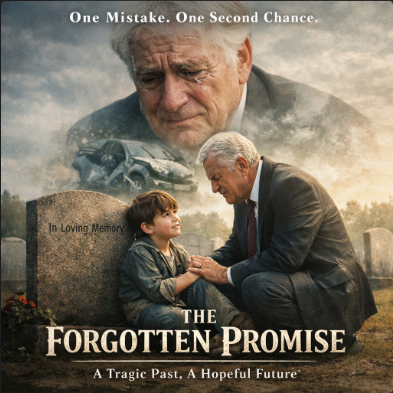
This old man’s one mistake will change this boy’s whole life for good.
People thought the old man came to the grave every morning to mourn someone he loved. They never noticed how he stood there—too stiff, too careful—like a man afraid of his own memories. On this morning, though, something was different.
A small boy lay asleep on the grave, curled up against the cold stone as if it were the only place that felt safe. Dust clung to his clothes. Hunger had made his breathing shallow. The old man froze when he saw him. His chest tightened, and his knees weakened, as if the ground itself was pulling him down.
He dropped to his knees.
Tears came without warning.
The boy stirred, rubbed his eyes, and looked at the stranger kneeling before him. There was no fear in his voice—only curiosity.
“Who are you, sir?”
The old man couldn’t answer. He tried, but the words stayed trapped behind years of silence. Instead, he wiped his face and forced a small smile.
“I’m… someone who made a mistake,” he said quietly.
The boy sat up. “Everyone makes mistakes,” he replied simply. “My mother said that.”
At the mention of her, the old man’s hands began to shake.
They talked slowly. The boy spoke about how he slept there because it felt closer to his parents. He said his father used to carry him on his shoulders when he was tired, and his mother always saved the biggest bite of food for him—even when there wasn’t much to eat. He said these things without crying, as if he had already learned that tears didn’t bring people back.
The old man listened, every word cutting deeper than the last.
“You must miss them,” he said.
The boy nodded. “But I think they’re not angry. They were kind people.”
The old man looked down at the grave. His reflection stared back at him from the polished stone—a man dressed well, respected by society, yet hollow inside. For a moment, he almost told the truth. Almost.
Instead, he asked, “Do you have anyone else?”
The boy shook his head. “No one. But it’s okay. I’m used to being alone.”
That sentence broke something in the old man.
From that day on, he returned—not just with tears, but with food. Then books. Then warm clothes. He didn’t explain why he cared so much. The boy didn’t ask. Somewhere between shared meals and quiet walks, trust grew.
Still, a mystery hung between them.
Sometimes, the old man would stare at the boy’s parents’ grave like a man standing at the edge of a cliff. Sometimes, late at night, he would wake up shaking, whispering apologies to an empty room. The boy noticed—but said nothing.
One evening, as rain began to fall, the old man finally spoke.
“Do you know how your parents died?” he asked.
The boy looked at him. “They said it was an accident.”
The old man closed his eyes.
“It was,” he said. “But accidents have faces. And hands. And names.”
He told him everything.
About the night he was driving too fast. About the poor road, the sudden turn, the small bike that appeared out of nowhere. About how wealth and power saved him from punishment—but not from guilt. About how he stood at this very grave for years, unable to forgive himself.
“I took everything from you,” he whispered. “And I don’t deserve your forgiveness.”
The boy was silent for a long time.
Then he reached out and held the old man’s trembling hand.
“My mother said,” the boy said softly, “that when someone is truly sorry, God gives them another chance—to fix what they broke.”
The old man looked up, stunned.
“I don’t need you to replace my parents,” the boy continued. “But… if you want to stay, you can.”
That was the moment the old man understood.
His mistake had taken two lives—but his choices from this day forward could shape another.
And so he raised the boy. Gave him education, warmth, love, and a future his parents had only dreamed of.
Not to erase the past.
But to honor it.



Nice story