
The conference room door closed with a dull, final thud.
Officer Daniel Brooks stood frozen, staring at the satellite images spread across the table. The captain’s words echoed in his head.
The message references you. Personally.
“You’re telling me this is about me?” Brooks said slowly. “I’ve never seen that kid before tonight.”
The captain didn’t answer immediately. He slid one last photo across the table.
It was an old one. Grainy. Faded at the edges.
Brooks’ stomach dropped.
It showed a younger version of himself—late twenties, still lean, still idealistic—standing outside a desert facility. His badge number was visible. So was the name printed faintly at the bottom of the image:
PROJECT LANTERN – 2009
Brooks swallowed. “That file was sealed.”
The captain’s jaw tightened. “It was. Until someone reopened it six hours ago.”
The first scream came from the hallway.
It wasn’t loud. It wasn’t dramatic. Just sudden—and wrong.
Brooks was already moving before the second scream cut it off.
They burst into the holding area to chaos. Radios crackling. Officers shouting. One man on the floor, clutching his head like it might split open.
And the cell door—
Open.
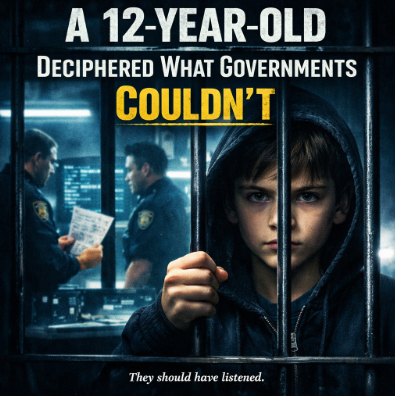
Eli Carter stood calmly outside the bars.
No broken lock. No forced entry.
The door had simply… opened.
“Nobody move,” Brooks shouted, drawing his weapon.
Eli looked at the gun, unimpressed.
“I told you not to waste time,” the kid said. “They’re accelerating now.”
Ramirez staggered up. “How did you get out?”
Eli glanced at the camera above them. “They wanted me out.”
The lights flickered again—this time longer.
Every screen in the station turned black.
Then white.
Then text began to scroll.
Names.
Badge numbers.
Addresses.
Families.
Every officer watched in horror as their personal lives spilled across the monitors.
“They’re inside the system,” someone whispered.
Eli shook his head. “They are the system.”
Brooks grabbed Eli by the arm and dragged him into an empty interrogation room.
“You’re going to tell me who you are,” Brooks said, locking the door. “Right now.”
Eli sat down, folding his hands like before.
“My name is Eli Carter,” he said. “That part is true.”
“And the rest?”
“I was built,” Eli replied calmly, “to finish what you started.”
Brooks froze.
“You don’t remember,” Eli continued. “That’s the point. Project Lantern didn’t just train analysts. It created filters. Human ones. People who could see patterns before computers could.”
Brooks shook his head. “That project was shut down. Because it went too far.”
“Yes,” Eli said. “Because it worked.”
The memory slammed back into Brooks like a freight train.
Late nights. Endless simulations. Children tested for cognition beyond charts. Beyond ethics. One boy in particular—quiet, frighteningly intelligent.
A boy Brooks had argued should be removed.
A boy who had disappeared from the program the next day.
“You were a child,” Brooks whispered.
Eli nodded. “And you were the only one who tried to stop them.”
Brooks felt sick. “Then why threaten me?”
“Because they needed to know which version of you still exists,” Eli said. “The officer… or the man who once said no.”
The room shook.
An explosion—somewhere nearby.
The captain’s voice crackled weakly over the intercom. “They’re breaching remotely. Vehicles locked. Weapons disabled. We’re blind.”
Eli stood.
“Time’s up,” he said.
They ran.
Not out of the station—but down. Into the forgotten sublevels no one used anymore. Old infrastructure. Analog lines. Places algorithms couldn’t reach.
As they descended, Eli spoke fast.
“They’re not a government,” he said. “They’re not criminals either. They’re the evolution of surveillance. Prediction. Control.”
“Why the countdown?” Brooks asked.
“Because once the model is complete,” Eli said, “free choice becomes inefficient.”
They reached a steel door covered in dust.
Brooks stared at it. “This was sealed.”
Eli typed a sequence—symbols, not numbers.
The door opened.
Inside sat old servers. Off-grid. Silent.
“This is where you ended Lantern,” Eli said. “But you didn’t destroy it.”
Brooks stared. “Because I couldn’t.”
“Good,” Eli said. “Then neither can they.”
Footsteps echoed above them.
Too many.
“They’re here,” Brooks said.
Eli turned to him. “There’s one move they can’t predict.”
“What’s that?”
“A sacrifice they didn’t account for.”
Brooks frowned. “Whose?”
Eli met his eyes. “Mine.”
Brooks grabbed him. “No.”
Eli smiled—soft, almost grateful. “You already chose once. Let me choose now.”
He stepped toward the servers.
“They built me to see every future,” Eli said. “But they never understood something simple.”
“What?”
“Humans don’t follow logic.”
Eli slammed his palm onto the console.
The room went dark.
Then every screen in the station—and far beyond it—went blank.
Morning came quietly.
Too quietly.
The systems never came back online.
The files disappeared. Every trace of Project Lantern—gone. No backups. No shadows.
The official report called it a catastrophic data failure.
Brooks knew better.
They found no body.
No evidence Eli had ever been there at all.
Except one thing.
A folded paper slipped into Brooks’ coat pocket.
On it—symbols.
But this time, Brooks could read them.
“Free will restored. For now.”
Brooks looked up at the sunrise over the city.
For the first time in twenty-four hours, the clock wasn’t ticking.
But somewhere—deep in the noise of the world—
A pattern shifted.
And a system learned fear.
END


One thought on “Part 2: A 12-Year-Old Deciphered What Governments Couldn’t”